Is Mercury Retrograde Right Now?
Frequently asked
Is Mercury retrograde right now?
When is the next Mercury retrograde?
Does Mercury actually move backward?
What does Mercury retrograde actually mean?
Is it true you shouldn't sign contracts or travel during Mercury retrograde?
What is the "shadow" or "retroshade" period?
How do I know if this retrograde affects me personally?
Is Mercury retrograde right now?

The box at the top of this page answers that in real time — it reads the live position of Mercury from the Swiss Ephemeris (the same arc-second source professional astrologers use) and reports whether the planet's apparent motion along the zodiac is currently forward (direct) or backward (retrograde), along with the sign and degree it's sitting in and the date of the next change. [src→ Mercury significations & stations]
As shown above, on June 9, 2026 Mercury is direct at 12°18′ Cancer. It is, however, just days from entering the shadow of its next retrograde (June 13), which stations retrograde on June 29. So if you arrived here sensing "something Mercury-ish" already gathering, that's not nothing — the shadow period is real, and we'll explain it below.
Every Mercury retrograde window, 2026–2027
Mercury typically retrogrades three times a year, for roughly three weeks each time, because of how its orbit and Earth's line up — more often than any other planet, most of which retrograde just once a year. Here are all the windows for the next two years, computed to the day. Each retrograde sits inside a longer shadow period: the stretch before the station, when Mercury first crosses the degrees it will later re-cross, and the stretch after it turns direct, until it clears those degrees again.
| Pre-shadow begins | Stations retrograde | Stations direct | Shadow clears | Sign |
|---|---|---|---|---|
| Feb 11, 2026 | Feb 26 · 22°34′ Pisces | Mar 20 · 8°29′ Pisces | Apr 9, 2026 | Pisces |
| Jun 13, 2026 | Jun 29 · 26°15′ Cancer | Jul 23 · 16°19′ Cancer | Aug 7, 2026 | Cancer ← next |
| Oct 4, 2026 | Oct 24 · 20°59′ Scorpio | Nov 13 · 5°02′ Scorpio | Nov 30, 2026 | Scorpio |
| Jan 25, 2027 | Feb 9 · 5°59′ Pisces | Mar 3 · 20°55′ Aquarius | Mar 23, 2027 | Aquarius–Pisces |
| May 26, 2027 | Jun 10 · 6°22′ Cancer | Jul 4 · 27°28′ Gemini | Jul 19, 2027 | Gemini–Cancer |
| Sep 17, 2027 | Oct 7 · 4°56′ Scorpio | Oct 28 · 19°19′ Libra | Nov 13, 2027 | Libra–Scorpio |
Dates shown in UTC for reference; the live 3D sky localizes each to your own time zone, since a station that lands at 11 PM in London is a different calendar day in Los Angeles. [src→ station dates · Swiss Ephemeris] For just this year's windows season by season, see Mercury retrograde 2026; for every other planet's retrograde this year — not only Mercury's — see what's retrograde now.
What "retrograde" really is (the planet never moves backward)
This is the part most worth understanding, because it dissolves a lot of needless worry. Mercury does not reverse course. It never stops, never slingshots backward, never does anything unusual to its orbit at all. It keeps circling the Sun in the same direction it always has.
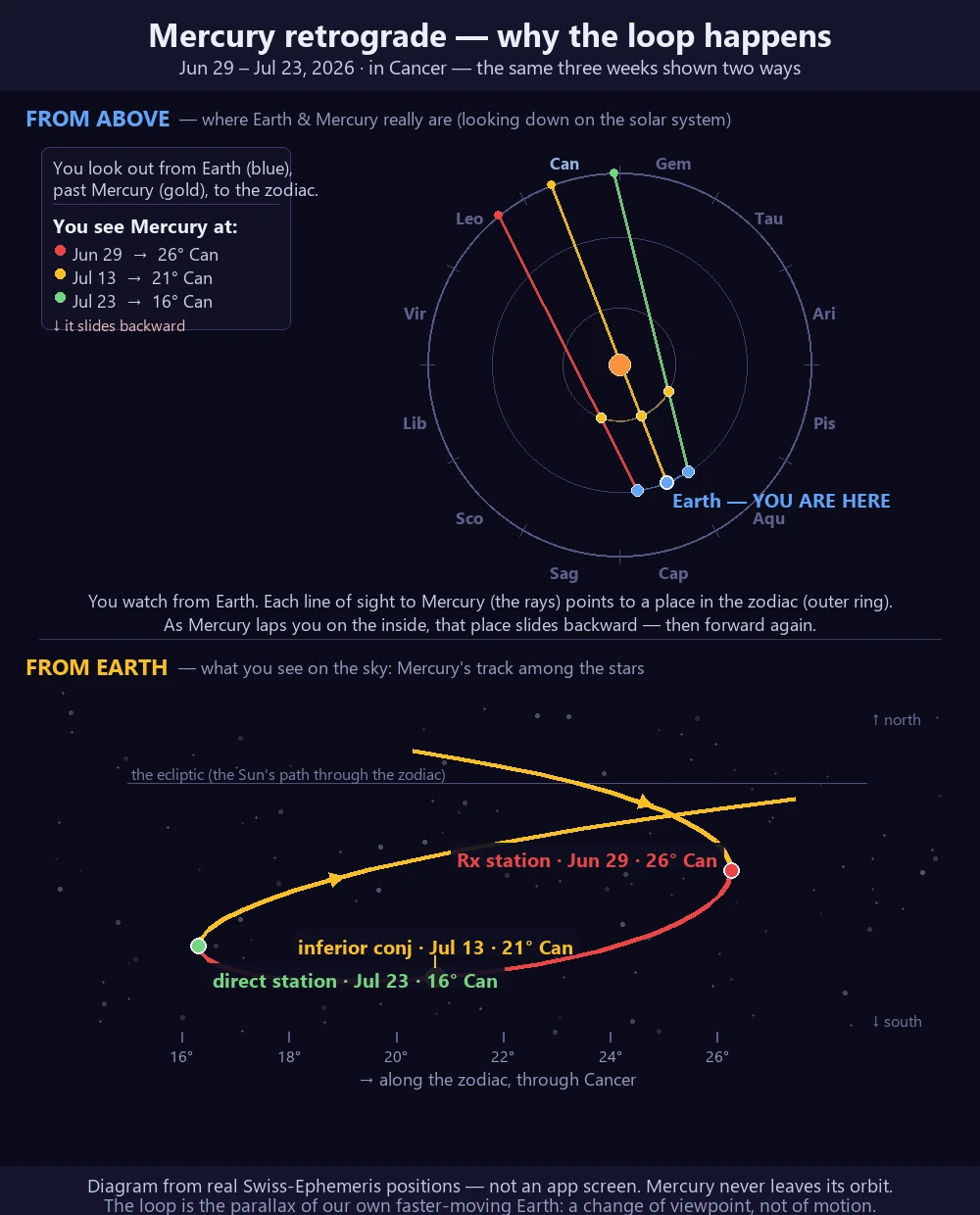
What changes is our viewing angle. We watch Mercury from Earth, and both planets are moving. Mercury is the fastest planet in the solar system — it laps the Sun roughly every 88 days — so it periodically catches up to and overtakes Earth on the inside, passing between us and the Sun (a moment called inferior conjunction). Right around that pass, the geometry of Mercury overtaking us makes the planet appear to drift backward against the fixed stars for about three weeks, before resuming its forward march. [src→ apparent motion · synodic cycle]
The everyday version: think of a faster car overtaking you on the inside of a bend. As it cuts across between you and the center of the curve, for a moment it seems to slide backward against the distant hills — even though it's racing forward the whole time. Mercury's retrograde is that illusion played out on the sky: as it overtakes Earth on the inside and swings between us and the Sun, it briefly appears to reverse against the fixed stars. The moments when the apparent motion pauses to change direction are the stations (retrograde and direct), and astrologers have always treated those still-points as the most concentrated part of the cycle.
Mercury never moves backward. It's the one doing the overtaking — Mercury laps us on the inside lane, swinging between Earth and the Sun, and for roughly three weeks the faster planet appears to drift in reverse. The geometry is real; the "reversal" is a point of view.
Why astrologers watch Mercury
In the tradition, Mercury is the planet of mind and exchange — speech and writing, learning and reasoning, messages, commerce and contracts, short journeys, the hands and the tongue. It's the planet that carries things between: ideas between people, goods between markets, signals between parts of a system. [src→ Mercury significations] Mercury was the messenger in more than one mythology, and the astrological meaning kept that thread.
So when Mercury's motion turns inward and backward-seeming, the long-standing reading is that its themes turn inward and backward too — toward the prefix "re-": review, revise, reconsider, repair, reconnect, return, research. The traditional counsel was never "everything breaks." It was closer to: this is a season better suited to going back over things than to launching them cold — finishing drafts rather than signing finals, re-reading the contract, calling the person you lost touch with. [src→ retrograde doctrine]
Fact vs. folklore — honestly
Mercury retrograde may be the single most famous idea in modern astrology, and fame tends to flatten nuance. It's worth separating three layers, with respect for each.
| The claim | How to hold it |
|---|---|
| "Mercury moves backward." | Astronomical fact, gently corrected: it's apparent motion, not real reversal. The geometry above is genuine and beautiful; the wording is just loose. |
| "It's a time to review rather than launch." | Traditional doctrine: a centuries-old reading of Mercury's significations under retrograde motion. Held as guidance, not physics. [src→ traditional retrograde counsel] |
| "Never sign anything / don't travel / back up your devices." | Modern pop framing: a useful folk-memory of the traditional caution, amplified online into hard rules. The honest version: it's a reasonable prompt to double-check communications and plans — not a prohibition. Plenty of contracts are signed in retrograde and are perfectly fine. |
None of these deserves a sneer. The "don't sign anything" reflex grew from a real observation that the tradition recorded long before the internet turned it into a meme, and even at its most overstated it nudges people toward a genuinely good habit: slow down and re-read. We'd simply encourage holding it as awareness, not anxiety. The sky is describing a rhythm, not issuing an injunction.
A single window, phase by phase
Take the next retrograde — summer 2026, in Cancer — and watch how the three phases unfold. (Cancer is the sign of home, family, roots and emotional security, so this particular window colors the usual "re-" themes toward domestic and emotional review — a season for tending the home and old family threads rather than, say, the contracts-and-commerce flavor a Gemini or Virgo retrograde would carry.) [src→ sign emphasis]
- Pre-retrograde shadow — June 13. Mercury, still moving forward, reaches 16°19′ Cancer — the exact degree it will later station direct on. From here on, you're inside the cycle's "first pass": the topics that will come back up for review are often seeded now. Quietly watch what arrives.
- Stations retrograde — June 29, at 26°15′ Cancer. The planet halts and turns. This is one of the two pivotal days. The three weeks that follow favor the "re-" work: revisiting, repairing, reconnecting — especially around home and family for this Cancer window.
- Stations direct — July 23, at 16°19′ Cancer. The second pivotal day. Mercury turns forward again, and what was under review starts to resolve and move ahead. Note it lands back on that same 16°19′ it shadowed on June 13 — the cycle closing its own loop.
- Post-retrograde shadow clears — August 7. Mercury finally re-crosses 26°15′ Cancer (its retrograde-station degree) and leaves the whole zone behind. The window is fully closed; forward momentum is clean again.
That's roughly eight weeks shadow-to-shadow for a three-week retrograde — which is exactly why a date-precise timeline is more useful than a single "Mercury is retrograde" yes/no. The texture is in the phases.
Is this retrograde actually touching your chart?
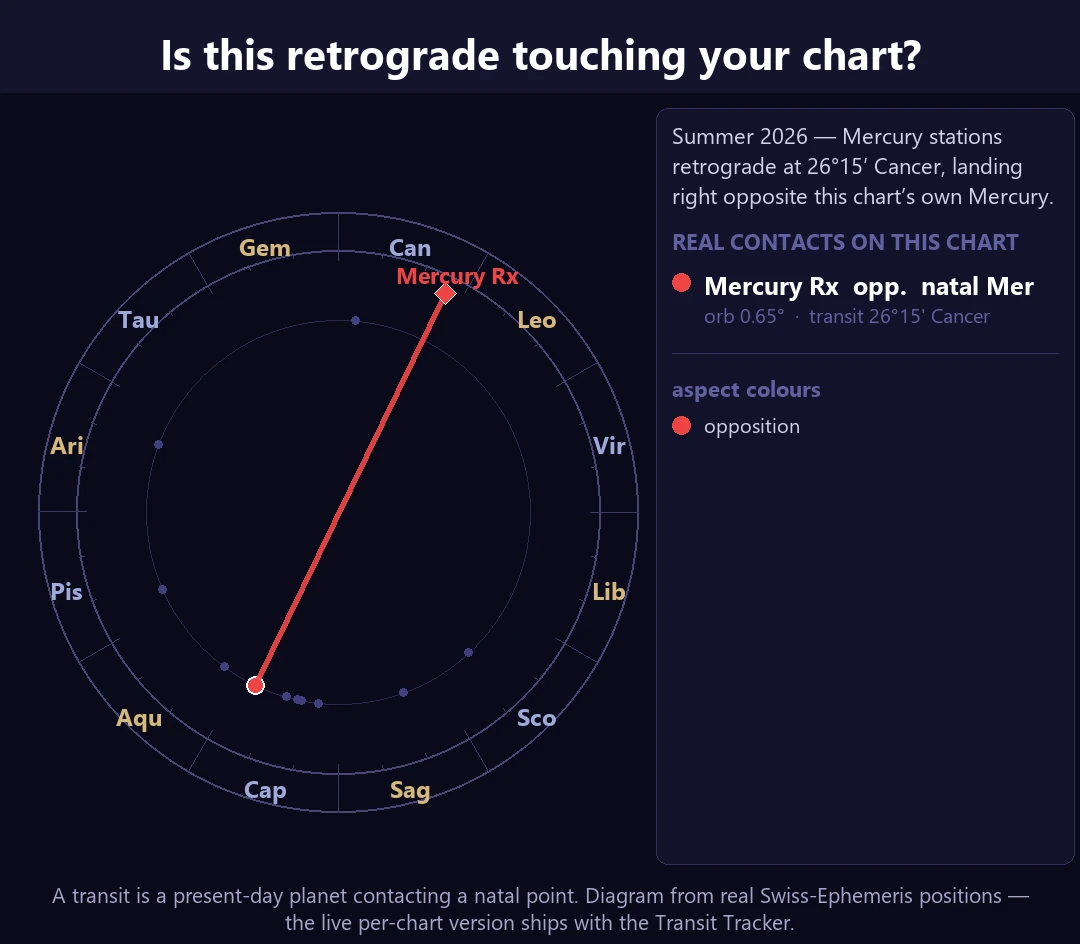
Here's the part a status banner can't tell you: a Mercury retrograde lands very differently depending on where it falls in your chart. If this summer's Cancer retrograde sits quietly in an empty patch of your chart, you may barely register it. If it stations exactly on your natal Sun, Moon, Mercury, or an angle, it can be one of the more pointed few weeks of your year — and which themes light up depends on the house and planet it touches. [src→ transits to natal]
This is a transit — a present-day planet making a geometric contact to a position in your birth chart — and it's the difference between a horoscope written for a twelfth of the planet and a reading written for your actual sky.
If Mercury retrograde makes you a little wary, that instinct is older and wiser than its meme. People have watched this planet pause and turn for thousands of years and read it as a cue to slow down and look again — and looking again is rarely bad advice. We'd just gently rebalance it from dread toward attention. The sky isn't out to get you; it's keeping a rhythm, and you're invited to keep time with it.
See exactly when Mercury — and everything else — hits your chart
Add your birth details and Zodisphere's Transit Tracker checks each station against your own chart: every contact this retrograde (and every planet) makes to your natal placements, scored by significance, on a calendar you can browse and compare. Same Swiss Ephemeris precision, written for your sky, not the average one. Free. (The Transit Tracker is rolling out from our transit-tracking work; until it lands on the main app you can already open this whole retrograde window live in 3D above.)