What Is a 3D Birth Chart? A New Dimension on a Timeless Map
<video> is a later optimization).Frequently asked
What is a 3D birth chart?
Is it different from a normal birth chart?
Does the 3D view change my signs or my reading?
Is a 3D chart "real" astrology, or just a graphic?
Can a 3D chart show declination or out-of-bounds planets?
So is Zodisphere saying the 2D chart is outdated?
Honoring the wheel
The round chart wheel is one of humanity's quietly great inventions. For more than two thousand years it has carried the whole of astrological practice on a single elegant diagram — a circle of the zodiac, the planets set around it, the houses dividing the sky of a given moment and place. It was refined across cultures and centuries: the sky-watchers of Babylon, the astrologers of the Hellenistic world who gave the chart much of its present shape, the scholars of the Arabic and Persian golden age, the traditions of India, and countless hands since. [src→ history of the chart wheel]
Its genius is its economy. The wheel distills the entire sky down to the one coordinate that matters most for reading a chart — each planet's ecliptic longitude, its position around the 360° circle of the zodiac (this is how you get "Mars at 14° Leo"). That single, disciplined choice is exactly what let a chart be drawn by hand, taught, memorized, and passed down for two millennia. A 3D chart doesn't improve on that. It owes everything to it.
What changed isn't the chart — it's the medium
A flat wheel records one number per planet because, for most of history, a chart lived on parchment, paper, or a printed page — and a flat page can hold a flat circle beautifully, but it cannot hold a sphere. So the tradition wisely kept the essential coordinate (longitude) front and centre, and noted the rest — a planet's distance, and its motion through time — in separate tables, for when they were needed.
What's new is simply that a screen can hold a sphere. So Zodisphere can render the same chart with longitude and distance — the depth a flat page can't hold — and let you turn it and play it forward. Nothing was missing from the wheel; the page just couldn't show depth or motion, and now the medium can. That's the whole idea: not a correction, but a continuation — the same map, finally able to occupy the dimension the sky actually has.
Parchment could hold a circle perfectly — but never a sphere. Nothing was missing from the wheel; only the page's ability to show depth and motion. Now the medium can.
The same chart, gently opening up
Here is one chart — our sample, January 1, 1990, New York — shown three ways. It is the same birth moment and the same planets at every step: first the chart as it has always been drawn, then that same chart inside Zodisphere kept flat, then opened into its full depth.
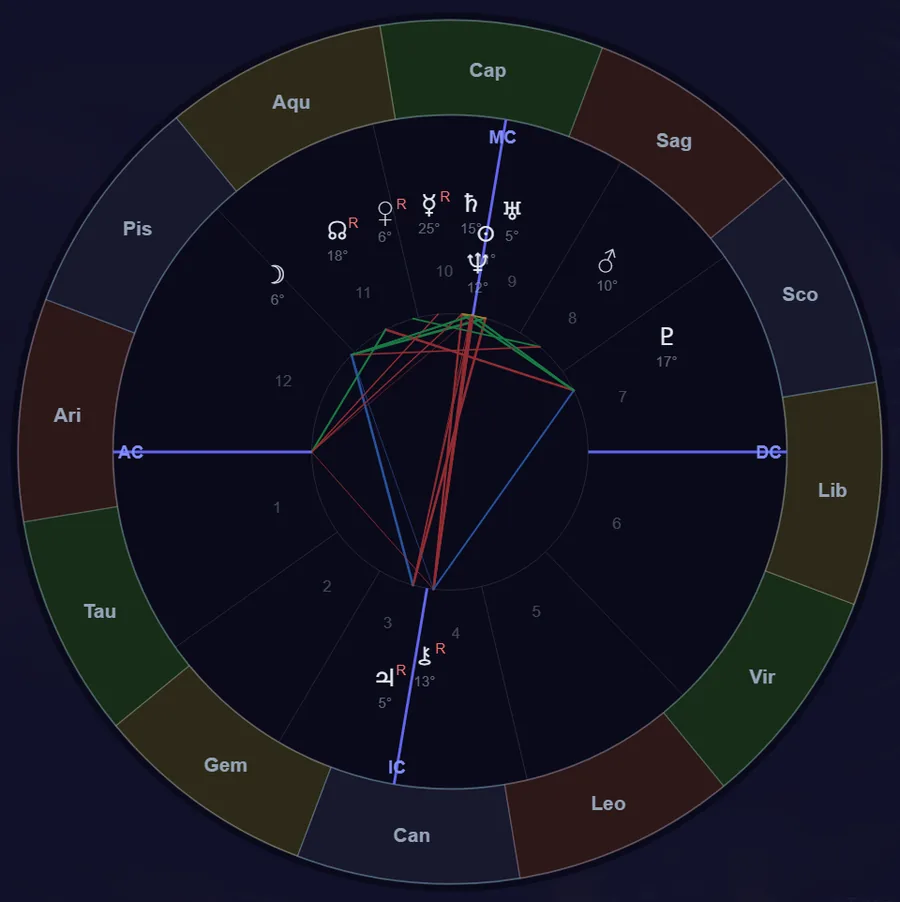
The round chart wheel, exactly as astrologers have drawn it for centuries — the zodiac around the rim, the twelve houses, the angles (Ascendant on the left, Midheaven up top), each planet placed by sign and degree, and the aspects traced across the centre. This is the heritage we begin from, and Zodisphere renders it faithfully.
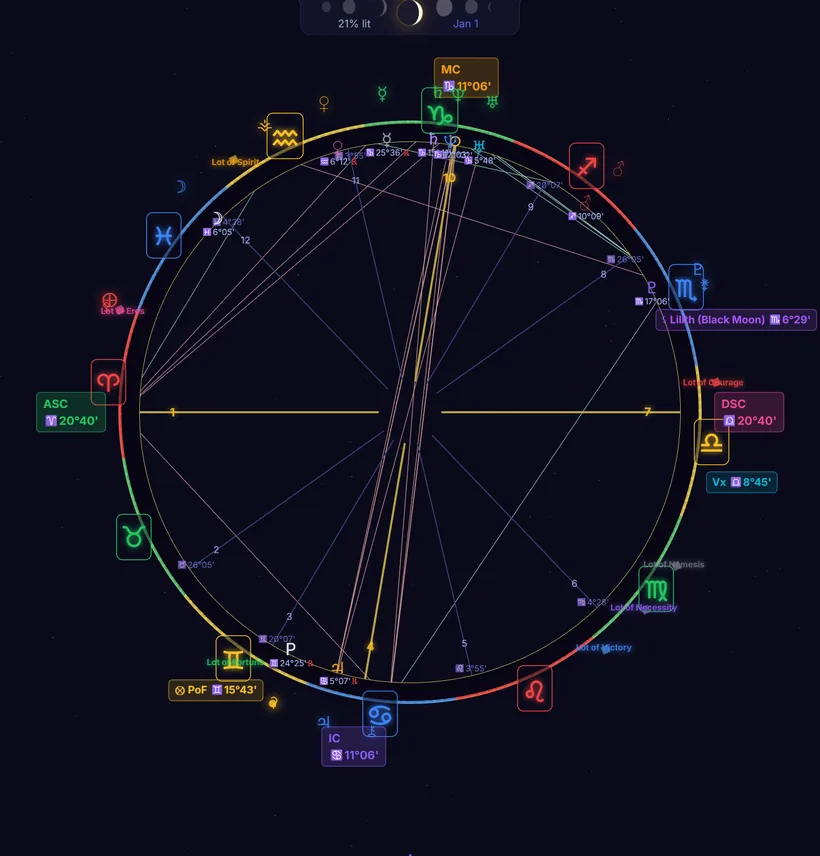
The identical chart, now living inside Zodisphere's interactive sky — but still kept flat and oriented exactly like the wheel above it: Ascendant on the left, Midheaven at the top, the same houses and signs, the major aspects traced between the planets' positions around the zodiac ring. Nothing has changed yet but the canvas it sits on — so your eye can carry straight over from the chart you already know.
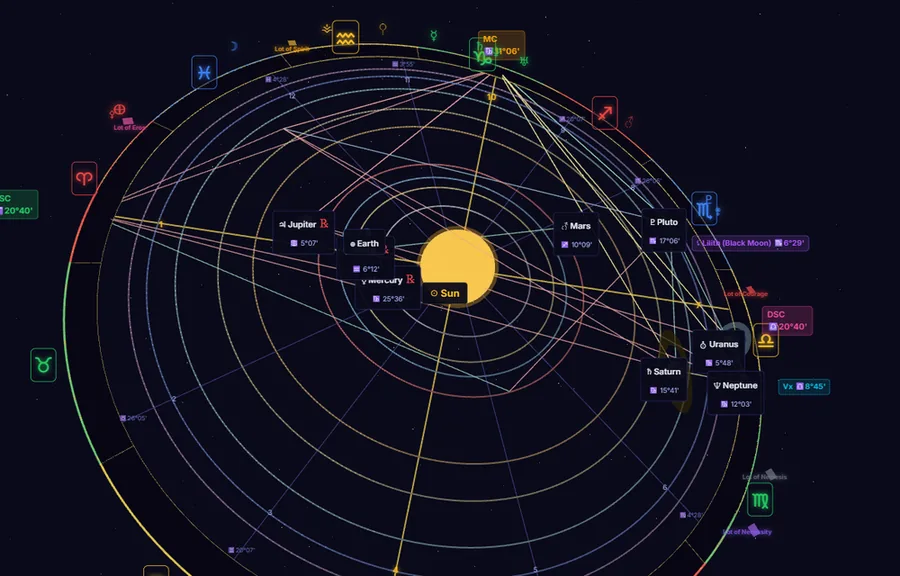
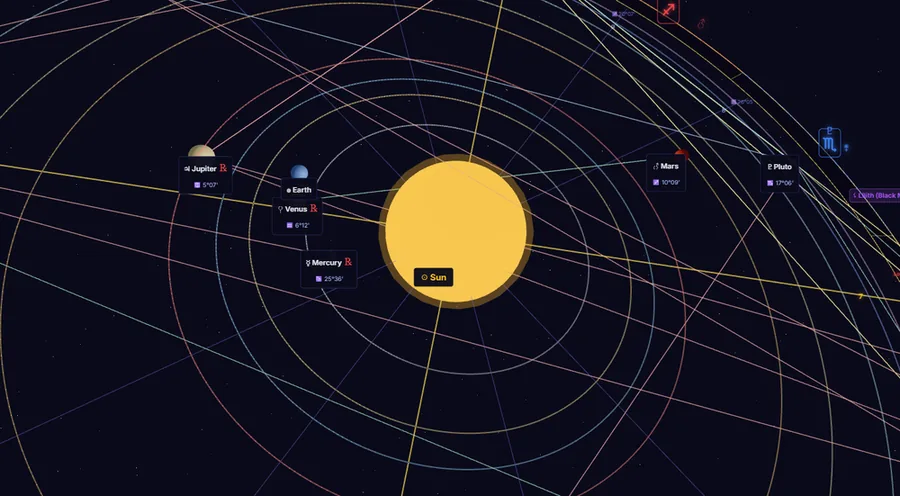
Now the planets step off the flat ring into their true places in space — Mercury, Venus, Earth close to the Sun, the giants further out — while the zodiac, houses, and angles stay exactly where the tradition puts them, as the outer frame. The aspects, too, now connect the planets' real positions rather than their marks on the ring. Same chart, same reading; you're simply seeing it whole. [src→ aspects in 3D]

That's the whole idea — not a replacement of the wheel, but the wheel allowed to breathe into the dimension it always implied. (And it keeps moving: the view up top is this same chart with the camera free to orbit, tilt, and zoom through it.)
- Rotate, tilt, and zoom the whole sky with a drag or a scroll — look at your chart from any angle.
- Travel inward from the face-on chart all the way down to a single planet, watching the planets' real distances and orbital arrangement open up as you go (the clip at the top of the page is exactly this move, on our sample chart).
- Toggle 2D ↔ 3D independently for the planet positions and the aspect lines — step between the flat wheel and the full depth whenever you like.
- Switch zodiacs and house systems (tropical/sidereal, Placidus, Whole-Sign…) and watch the framework turn against the same fixed planets.
- Press play on time and watch the planets move — see a retrograde loop or a transit unfold in real geometry.
- Tap any planet, sign, or point to open its sourced glossary entry.
<img> with descriptive alt + caption.What the third dimension lets you see
The flat wheel keeps the one coordinate that does most of the reading — each planet's zodiac longitude. The 3D view keeps every bit of that and restores the dimension a flat page had no room for: depth. Here is what that actually opens up — and, just as honestly, which layer of the craft it does not draw.
Depth and distance — the radial dimension the wheel can't hold
This is the heart of it. On a flat wheel every planet sits the same distance from the centre — a circle has no "in and out." In 3D each planet sits at its true relative distance: Mercury, Venus and Earth close to the Sun, then Mars, then the long reach out to Jupiter, Saturn, and the distant giants. Suddenly the chart has a scale — you can see how tightly the inner system is packed and how far the outer planets really range, the radial coordinate the page simply had nowhere to put. [src→ planetary distances]
The orbital arrangement, from any angle
Because the planets are placed in space rather than on a ring, you see the shape of the system itself — the inner planets and the outer planets, each in its orbit, with the orbital paths drawn in. Rotate, tilt, and zoom and the same chart reads differently from a new vantage: looking down from "above" the solar system, edge-on along the plane, or in close on the cluster of inner planets. The wheel gives you the longitudes at a glance; the 3D view gives you the layout those longitudes live inside.
Retrograde as the motion it really is
On the wheel a retrograde planet wears a small ℞. The tradition always understood what it meant: not that a planet truly moves backward, but that we watch it from a moving Earth, so its apparent path loops when the geometry lines up — the inner planets (Mercury, Venus) overtaking Earth on the inside near inferior conjunction, the outer planets overtaken by Earth near opposition. Press play in 3D and you can watch that loop draw itself, exactly as the geometry has always described. We keep this brief here — the full apparent-motion story lives on our Mercury retrograde page.
The two zodiacs, toggled against the same planets
Switch between the tropical zodiac (anchored to the seasons) and the sidereal zodiac (anchored to the constellations) and watch the framework turn against the same fixed planets, live. The roughly 24° between them is the slow precession of the equinoxes — a drift Hipparchus noticed over two thousand years ago — and it's the reason a Western and a Vedic chart can place the same Sun a sign apart. [src→ tropical vs sidereal] Two traditions, one sky, shown together with respect for both.
The declination layer — in its own tool, not the 3D scene
There's one more layer worth knowing about, and it's important to be precise about where it lives. Beyond its zodiac longitude, each planet also has a declination — its angle north or south of the celestial equator (a different reference circle from the ecliptic the chart sits on). When a planet's declination passes the Sun's own yearly maximum — about 23°26′ (23.44°) north or south, the tilt of Earth's axis — astrologers call it out of bounds, and have long read such planets as operating a little outside the usual rules: exceptional, gifted, hard to contain. [src→ out-of-bounds] There's also a whole family of aspects measured in declination rather than longitude: two planets at the same declination form a parallel (read much like a conjunction), and at equal declinations on opposite sides, a contraparallel (read like an opposition). [src→ parallels and declination]
This declination layer is real, traditional craft — but it isn't what the 3D scene draws. The 3D view is built on depth and motion along the ecliptic; declination is measured against the equator, a separate frame. So Zodisphere computes and surfaces declination, out-of-bounds planets, and parallels in a dedicated Declination panel — its own tool, distinct from the 3D view. Think of them as two instruments for two layers: the 3D view for the planets' distances, arrangement, and motion; the Declination panel for the equatorial layer the older astrologers tracked by hand from their tables.
Is it still "real" astrology?
Entirely. The positions come from the Swiss Ephemeris — the same arc-second source professional astrologers rely on — and the interpretation is unchanged. You are reading the identical chart the tradition reads; you're simply seeing it in the dimension it occupies. [src→ Swiss Ephemeris]
Same chart, two views — each with its strengths
Neither view is "better." They are one chart seen two ways, and each is the right instrument for different work:
| What you're doing | The flat wheel | The 3D view |
|---|---|---|
| Reading signs, houses & major aspects at a glance | ✓ the master tool — fast, legible, time-tested | Shown too, but the wheel is usually quicker |
| Distance, depth & the orbital arrangement | A circle has no "in and out" — kept in distance tables, by tradition | ✓ the 3D view's core reveal — true relative distances, seen from any angle |
| Understanding why a planet is retrograde | Marked with a ℞ | ✓ watch the geometry as time plays |
| Comparing tropical & sidereal frameworks | Two separate charts | ✓ one sky, frameworks toggled live |
| Declination, out-of-bounds & parallels | Kept in a separate table, by tradition | Computed in Zodisphere's Declination panel (a separate tool, not the 3D scene) |
| The shared language of the craft | ✓ every astrologer reads it | A teaching companion to it |
Where the wheel still leads
We reach for the flat wheel constantly, and we'd encourage you to as well. It earns its place:
- The core of the craft is longitude-based — signs, houses, the major aspects, the dignities. The wheel was perfected to make exactly those legible at a glance, and for that it is often the clearer, faster instrument.
- It is the shared language. Every astrologer alive reads the wheel; it is how the tradition talks to itself across centuries and schools.
- Declination work is a real but specialist layer. Zodisphere's Declination panel surfaces it for those who want it — it isn't required, and many fine astrologers rarely need it.
Think of the 3D view as the one that teaches — it shows you the depth and motion the sky really has — while the wheel remains the worktop the reading is done on. The best practice is to keep both close.
With gratitude to the mapmakers
None of this is ours to claim. The chart, the houses, the aspects, the careful tables of declination and distance — all of it was built, tested, and handed down by generations of astronomers and astrologers across many cultures, long before any screen existed. Zodisphere's contribution is small and grateful: to take that inheritance and let it be seen in the round, wired to Swiss Ephemeris precision, a multi-tradition engine, and a cited glossary so every body and idea comes with its sourcing. We think of it as adding one modest line to a conversation that has been going on for two thousand years — and being honoured to be part of it at all.
The 3D view shows you where everything stood. The free personalized reading tells you what it tends to mean — placements, aspects, and houses, interpreted in plain language. Get your free reading →
See your own chart in three dimensions
Your 3D birth chart uses the same Swiss Ephemeris positions as any professional chart — the timeless wheel you know, free to rotate into its full depth and play forward through time, with tropical/sidereal and house-system options and a sourced glossary woven through. Free.
Create your free birth chart →