Solar Return Calculator
- Exact return moment (New York)Jan 1, 2026 · 5:47 AM
- Sun returns to11°02′ Capricorn
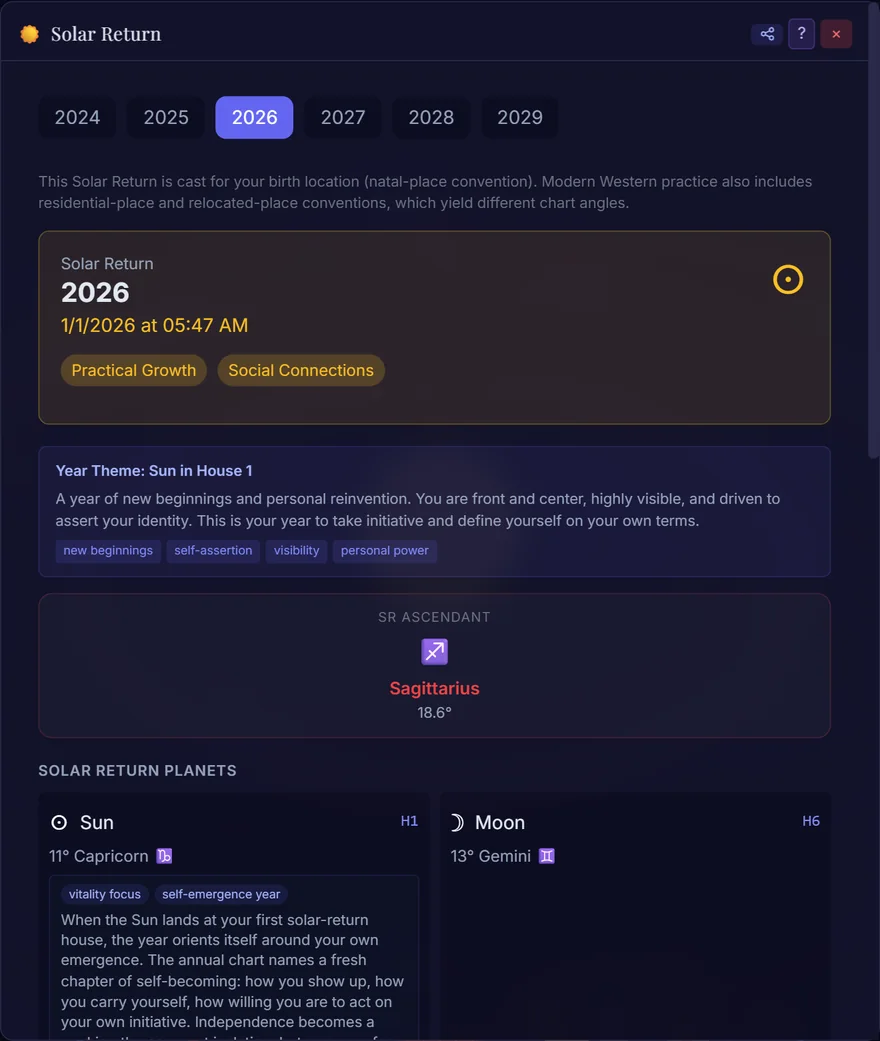
- Solar Return Ascendant18°33′ Sagittarius
- Chart valid for~1 year (to next birthday)
Frequently asked
What is a solar return chart?
How do I read a solar return chart?
Does location matter for a solar return?
Is the solar return on my actual birthday?
What is the solar return Ascendant?
How accurate are these dates and degrees?
What a solar return actually is
Once a year, the Sun comes back to the exact spot it held the day you were born — down to the degree, minute and second of the zodiac. A solar return chart is the chart drawn for that precise instant: "cast for the precise moment when the transiting Sun returns to its exact natal position … Each year the Sun returns to this natal placement, and the time of return can be calculated to create a chart for that moment." [src→ solar return technique] [common-knowledge: the Sun returns to its natal longitude annually.]
Astrologers read that chart as a temporary natal chart for the year ahead — a snapshot interpreted as spanning roughly one year, birthday to birthday, and read for the themes, opportunities and challenges of that cycle. [src→ solar return technique] It doesn't replace your birth chart; it's a fresh annual lens laid over the same life. People often call it their "astrological birthday," and the chart for it their "birthday chart."
It belongs to a family of return charts — charts cast for the moment a planet comes back to its birth position. The solar return is the yearly one, because the Sun completes its circuit in a year; its slower cousin, the Saturn return, happens only about once every 29 years, when Saturn regains its natal degree. Same idea, very different clock.
A solar return is the chart of the one moment each year the Sun stands again exactly where it stood when you were born — read as a temporary natal chart for the twelve months to your next birthday.
The exact moment — and why it isn't your birthday party
Here's the first thing the simple "happy solar return!" posts skip: the return is a moment, not a day, and that moment drifts. The Sun's actual year (about 365.25 days) runs a quarter-day longer than the 365-day calendar, so the return lands roughly six hours later each year — then leaps back after a leap year resets the count. [src→ solar return technique]
For the sample chart — January 1, 1990, New York, with the natal Sun at 11°02′ Capricorn — that drift looks like this across four recent years (New York local time):
| Year | Exact return moment (New York) | Drift |
|---|---|---|
| 2024 | Jan 1, 2024 · 6:15 PM | — |
| 2025 | Jan 1, 2025 · 12:00 AM | ~6 h later → midnight |
| 2026 | Jan 1, 2026 · 5:47 AM | ~6 h later |
| 2027 | Jan 1, 2027 · 11:37 AM | ~6 h later |
This person was born around noon, yet their return is almost never at noon — it walks around the clock from one year to the next. And because the moment migrates, it can fall on the day before or the day after your calendar birthday: the source notes the return time "may occur a day or two before or after the birthday due to the approximately six-hour annual shift." [src→ solar return technique] Knowing the exact moment is what lets the chart be cast at all — and it's why a real calculation beats "sometime around your birthday."
Why where you spend your birthday changes the whole chart
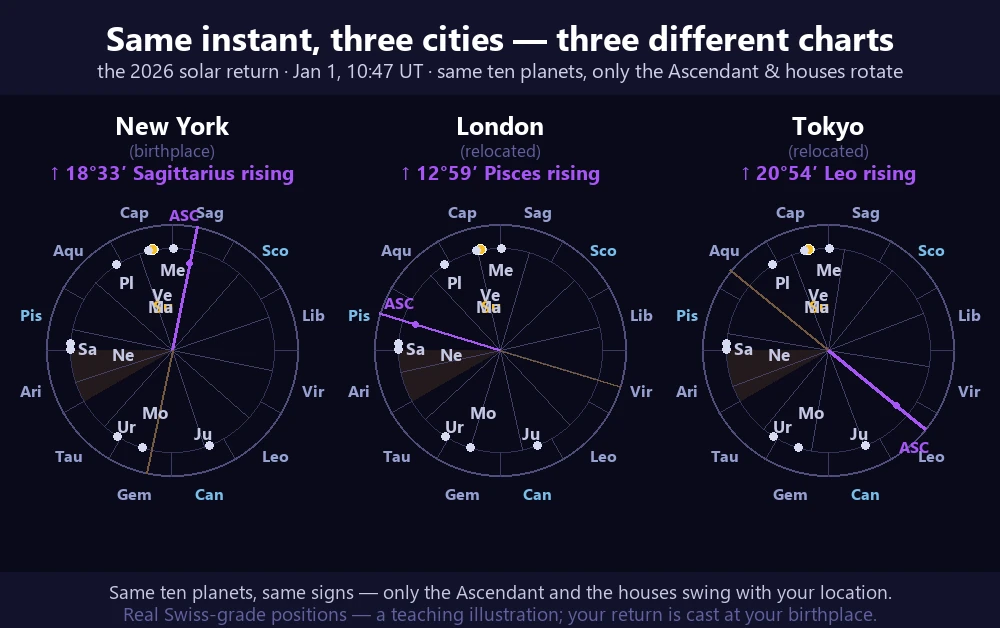
This is the part most calculators hand you without explaining — and it's the most interesting thing about the technique. The return moment is a single instant in time, the same everywhere on Earth. So the planets fall in the same signs no matter where you are: at this sample's 2026 return the Sun is at 11°02′ Capricorn whether you're in New York, London or Tokyo. But the Ascendant, the Midheaven and the house framework rotate with your location. As Mary Shea puts it, "the Ascendant, Midheaven, and the orientation of planets in the solar return wheel will slowly rotate as you move east or west." [src→ relocation]
That's not a quirk — it's geometry. The Ascendant is the degree rising on the eastern horizon, which depends on your local sidereal time and your latitude; move to a different longitude or a different latitude and a different degree is rising at that same instant. [common-knowledge / Swiss-computable.] The result: one return moment, genuinely different charts. Here is the same 2026 instant cast for three cities:
| Where you spend the birthday | Solar Return Ascendant | What rotates |
|---|---|---|
| New York (this chart's birthplace) | 18°33′ Sagittarius | The whole house framework anchors here |
| London (if you travelled) | 12°59′ Pisces | Same planets, a different rising sign & houses |
| Tokyo (if you travelled) | 20°54′ Leo | Again the same planets, a third framework |
Three rising signs, three house frameworks for the year — from one identical moment. It's why the old saying among practitioners is that for a solar return it matters less how you spend your birthday than where.
Stand inside the moment, in 3D
Knowing the moment the Sun comes home is one thing; seeing the sky at that instant is another. Because Zodisphere is a real-time solar-system viewer, the return is also a place you can go. Open the 2026 return in 3D and the app winds the clock to that exact instant — so you can watch the Sun sitting precisely back on the degree it held at this birth, with the rest of the planets arranged around it, from any angle.
2026-01-01T10:47:00.000Z) — the real sky as it stood when the Sun came home. Rotate it, zoom in, or press play. It sets the date and opens the live Explorer; it does not overlay your personal solar-return chart. Reading the return as your own chart — Ascendant, houses, the planets in their return positions — is what the Solar Return tool and the Year Ahead page are for.
How to read your solar return
A solar return rewards a handful of clear moves rather than a deluge of detail. The order below follows the way practitioners actually work it.
1. The rising sign and its ruler
Start with the Solar Return Ascendant — the degree rising at the return moment — and the planet that rules it. The rising sign colours the year's overall temperament and outward style; its ruling planet becomes, in effect, the steward of the year, so where that planet sits by house tells you a great deal about where the year's story plays out. [src→ SR Ascendant] Planets sitting right on an angle — close to the Ascendant, Descendant, MC or IC — are read as "more prominent and powerful" and tend to define the year. [src→ SR Ascendant]
2. Houses over signs
In a solar return, which house a planet falls in usually matters more than its sign. Shea's reasoning is concrete: the Sun never changes sign, Mercury is always near the Sun, Jupiter moves only a sign a year, and the outer planets share a sign with everyone that year — so sign carries limited yearly information, while the house tells you which area of life gets the energy. [src→ house priority] A planet near a house cusp can be read for both houses, and will be activated more strongly when transits cross that cusp later in the year. [src→ house priority]
3. Where the planets pile up
Look for a stellium — four or more planets in a single house. That concentration pulls the year's attention and circumstances toward that house's affairs, sometimes to the neglect of everything else. [src→ stellium] A return with a 7th-house stellium will be a relationship year; one with everything in the 10th, a year of public standing and work.
4. Read it as its own chart
You can read a solar return largely on its own, as a temporary natal chart for the year — Shea's considered position is that about "ninety percent of the necessary information comes from the solar return chart itself," with the natal chart adding background rather than being essential. [src→ single-chart method] If you do compare the two, place the solar return on the inner wheel so its house structure stays intact. [src→ single-chart method] The chart is valid for roughly one year, until the next return.
<img> with descriptive alt + caption.Worked example — the sample's 2026 return
Putting the moves together on the sample chart (Jan 1, 1990, New York; natal Sun 11°02′ Capricorn), cast at its birth location for 2026:
The Sun comes home at 5:47 AM on Jan 1, 2026, with 18°33′ Sagittarius rising — which makes Jupiter, the ruler of Sagittarius, the steward of the year, so where Jupiter sits by house is the first thing to chase down in the full chart. [src→ SR Ascendant] From there you'd note the house each planet occupies (where the year's energy is directed), any planet sitting on an angle (it will define the year), and any house holding a stellium. The specific house positions and per-placement notes are exactly what Zodisphere's Solar Return tool generates for a real chart — this page funnels you to it rather than guessing them here.
Had this person spent the 2026 birthday in London instead, the rising sign would be 12°59′ Pisces — a Jupiter-ruled (and, in modern practice, Neptune-ruled) Ascendant — and in Tokyo, 20°54′ Leo, a Sun-ruled one. Same planets, same aspects; but a different rising sign, a different ruler stewarding the year, and a different house framework as the doorway into them. That is the whole point of casting it for a real place rather than reading a generic "Sun sign" forecast.
The solar return is one of astrology's most elegant ideas: take the single most reliable clock in the sky — the Sun's yearly homecoming — and let it open a fresh chart for the year. Generations of practitioners refined how to read it, and there are several honourable conventions for where to cast it (natal-place, residential, exact-location) and whether to read it alone or against the birth chart. We hold all of them with respect; Zodisphere simply makes one clear, honest choice — your birth location — and tells you so, while teaching the relocation idea so you understand the whole technique. The aim isn't to "beat" the familiar birthday-chart tools, but to hand you the same calculation with its reasoning shown, sourced to the people who worked it out. [src→ relocation conventions]
Read your own solar return — then stand inside the moment
Enter your birth details and open the Solar Return tool (in the Explorer's Forecasting group — it also powers the Year Ahead page) to get your exact return moment, your rising sign and its ruler, and your planets in their return houses, with sourced notes — cast for your birth location with the convention disclosed. Then open the moment in Zodisphere's live 3D solar system. Free. (And when our Transit Tracker finishes rolling out, it will show everything else moving through your chart across the return year — until then, the 3D deep-link is the live action that works today.)
Read my solar return → or see the sample return moment in 3D →