Astrocartography Calculator
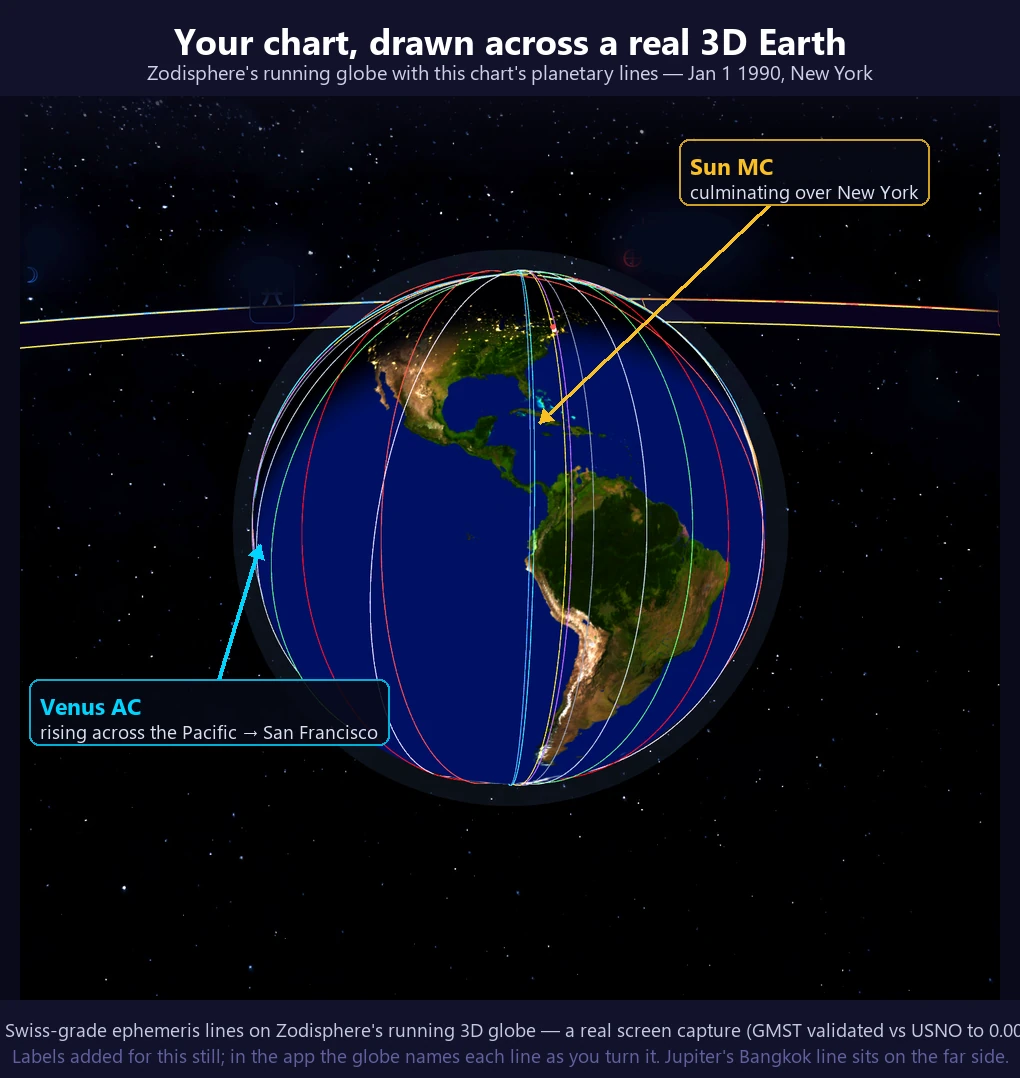
- Sun MC line — runs throughNew York (33 km)
- Venus AC line — passes nearSan Francisco (171 km)
- Jupiter MC line — passes nearBangkok (138 km)
- Mercury DC line — passes nearRome · London · Paris
<img> with descriptive alt + caption.Frequently asked
What is astrocartography?
What do the MC, IC, AC and DC lines mean?
Which line should I look for — career, love, or home?
How close to a line do I have to live for it to count?
Is astrocartography the same as a relocation chart?
Is astrocartography scientifically proven?
What astrocartography actually is
Your birth chart is a snapshot of the sky from one spot on Earth, at one instant. Astrocartography asks a different question of that same instant: if you stand somewhere else on the planet, where would each of your planets have been in the sky? Specifically, it finds — for all ten planets — the lines on the globe where each one sat exactly on one of the four chart angles at your birth moment. [src→ astrocartography (Jim Lewis)]
The technique was originated by the American astrologer Jim Lewis (1941–1995), who set it out in his 1976 book Astro*Carto*Graphy. Lewis's idea was that these lines show, in his words, "how an individual can find a favorable location on the earth's surface" — and the method "charts the lines of planetary angularity" — conjunct the Ascendant, Midheaven, Descendant, and Imum Coeli — "across the globe." It's a 20th-century, computer-era innovation, and one that, as the historian James Holden notes, "has proved to be particularly popular in Europe." [src→ astrocartography (Jim Lewis)]
The underlying intuition is older. Decades earlier, writers such as L. Edward Johndro had already imagined projecting "the zodiac-idea on the Earth surface," determining "which locality belongs to which sign" — an early astro-locality strand that the astrologer Dane Rudhyar recorded in the 1930s. [src→ astro-locality precursors] Lewis's contribution was to make it systematic, mappable, and — eventually — printable by computer.
A line on an astrocartography map is simply this: the place on Earth where a particular planet was sitting on a particular angle the moment you were born. The Sun's MC line is where the Sun was culminating — highest in the sky, on the meridian; a Venus AC line is where Venus was rising.
Reading the lines: planet × angle
Here is the single most useful thing to understand, and the part most flat-map sites skip. A line is never just "a Venus line." It's always a planet meeting one of four angles, and you read it by combining two things you may already half-know — what the angle governs, and what the planet is about.
The four angles each carry a well-established area of life, the same one that angle's house governs in any chart [src→ the angles (MC/IC/AC/DC)]:
| Line | Where the planet was | The life-area it colours |
|---|---|---|
| MC (Midheaven) | Culminating — top of the sky | Career, vocation, public standing, reputation |
| IC (Imum Coeli) | At the bottom — lowest point | Home, roots, family, the private foundation |
| AC (Ascendant) | Rising on the horizon | The self, identity, how you meet the world, fresh starts |
| DC (Descendant) | Setting on the horizon | Partnership, relationships, open dealings with others |
And each planet brings its own traditionally attested nature [src→ planetary natures] — to take the ones in our worked examples: the Sun is vitality, recognition and identity; Venus is love, beauty, harmony and relating; Jupiter is expansion, opportunity, growth and optimism; Mercury is communication, commerce and learning. (The slower planets carry weightier themes — Saturn structure and limit, Uranus disruption, Neptune dissolution, Pluto deep transformation.)
Put the two together and you have the honest reading rule: a line is that planet's nature, lived through that angle's life-area, in that place. A Jupiter MC line is a place where Jupiter's expansion and opportunity are traditionally said to colour your career and public standing; a Venus AC line is a place where Venus's grace and warmth are said to colour how you present yourself and begin things. We compose it this way deliberately, from the angle plus the planet — there is no ancient "what your Venus MC means in Lisbon" doctrine to quote, and we won't invent one.
Which line for which goal — three grounded examples
Because the angles map onto real concerns, you can read an astrocartography map goal-first: career → MC, home → IC, relationships → DC, a fresh start or new visibility → AC. Let's walk three real lines from the sample chart, so the rule stops being abstract.
Notice what the map gives you that a list of "good places to live" never could: it's specific, it's yours, and it tells you not just where but which part of life each place tends to emphasise.
How close is close — and is it real?
Two honest caveats, because they're where the integrity of this technique lives.
On distance. The influence is strongest on the line and tapers as you move away from it. Many practitioners cite an influence band of a few hundred miles, with a wider, weaker "crossing" zone beyond. But there is no single agreed figure — different astrologers use different rules of thumb — so treat distance as a gradient, not a fence, and any specific mileage as a convention rather than a measurement. [src→ orb of influence] (Our proximity readouts above — 33 km, 171 km, and so on — are exact geometric distances to the line, which is a precise thing; how much "influence" that translates to is the interpretive part.)
On whether it's "real." We'll say it plainly: astrocartography is a symbolic, traditional technique, not an empirically validated one. The astronomy beneath it is exact — the lines are computed from real planetary positions — but the meanings attached to those lines are interpretive, the way all chart symbolism is. Held as a lens for reflection it can be genuinely illuminating; held as a guarantee that moving to a Jupiter line will make you rich, it will let you down. Honesty about that is, we think, the most respectful thing one can offer a beautiful old idea. (Every sourced claim on this page resolves to its book and page on our sources page.)
Astrocartography vs a relocation chart
People often use these two terms interchangeably, but they're distinct tools that pair well. [src→ ACG vs relocation chart]
An astrocartography map is the global, bird's-eye view: it draws where each planet is angular across the whole Earth at once, so you can scan continents for lines. A relocation (or locality) chart zooms all the way in: it recomputes your entire birth chart for one specific place — same birth moment, same planetary longitudes, but the Ascendant, Midheaven and all the house cusps recalculated for that location — giving you the full relocated wheel to read in detail.
As the corpus glossary puts it, the two "sit alongside" each other: ACG "maps planetary-line angularity globally, while the locality chart gives the full relocated house-wheel." [src→ ACG vs relocation chart] In practice you use the map to spot candidate places, then a relocation chart to study one in depth. Neither is "better" — they answer where and what's-it-like-there respectively, and they share the same modern-Western lineage.
<img> with descriptive alt + caption.The part most maps can't show: your lines on a real Earth
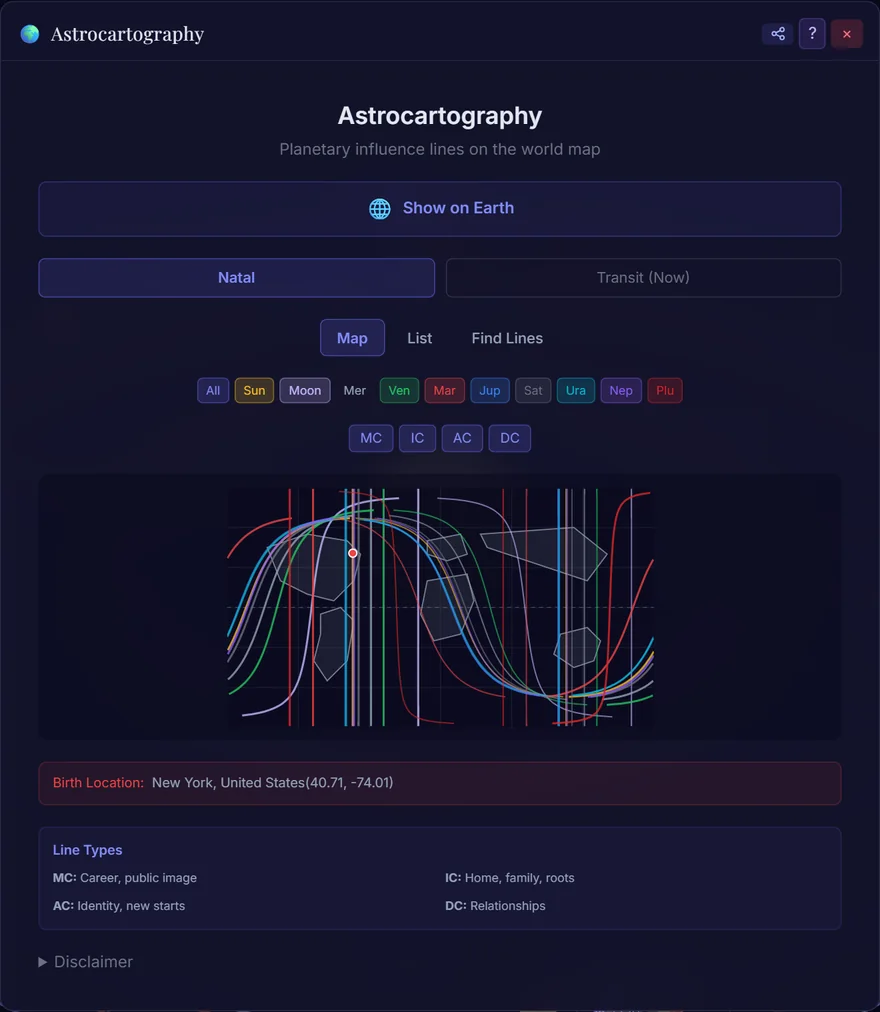
Most astrocartography tools hand you a flat rectangle of the world with coloured lines laid over it — and that's a perfectly good, time-honoured way to read the technique. Zodisphere draws that flat map too. But because Zodisphere is a real 3D solar-system viewer, it can also do something the flat projection can't: draw your 40 lines onto an actual rotating globe, where the MC and IC lines fall as true meridians and the AC/DC lines curve exactly the way the geometry says they should — the curve coming from the fact that where a planet rises and sets depends on its declination and your latitude.
The precision under it is real. The lines are computed from Swiss-grade positions, the app's sidereal-time calculation is validated against the U.S. Naval Observatory to within 0.004 seconds, and — a small but genuine nicety — it uses each planet's true position off the ecliptic rather than the flat-ecliptic shortcut many tools take. That matters most for Pluto, which in this chart sits over 15° off the ecliptic, materially shifting where its line falls. [src→ astrocartography (Jim Lewis)]
Astrocartography is one of the more quietly poetic ideas in modern astrology: that the sky of your birth, the same sky everyone shares, falls differently across the Earth depending on where you stand under it. We hold both the flat-map tradition and Jim Lewis's elegant systematization with real respect — they're the shoulders this page stands on, and the simple printed map is still where most people first meet the technique. Our only addition is to draw the lines where they actually live, on a round Earth, and to be candid that the geometry is exact while the meaning is symbolic. Used that way — as a thoughtful lens, not a verdict — it's a lovely way to look at your own chart and the world at once.
Draw your own astrocartography map — on a real 3D Earth
Generate your free birth chart, then open the Astrocartography tool in the Explorer and choose “Show on Earth” to see all 40 of your planetary lines drawn on a rotating globe, with a city search for the nearest lines and exact distances. Same Swiss-grade precision the professionals rely on. Free. (The personal overlay needs your birth details and the Astrocartography tool open — a link alone won't draw your lines.)
Generate my birth chart → or see how a birthday chart shifts by location →