The Moon Right Now: Phase, Sign & Void of Course
Frequently asked
Is the Moon void of course right now?
What sign and phase is the Moon in today?
What does void of course actually mean?
Is the "don't start anything during a void Moon" rule real, or overstated?
When is the next New Moon and Full Moon?
How long does a void-of-course Moon last?
What's a good use of a void Moon if I shouldn't start things?
What the Moon is doing right now
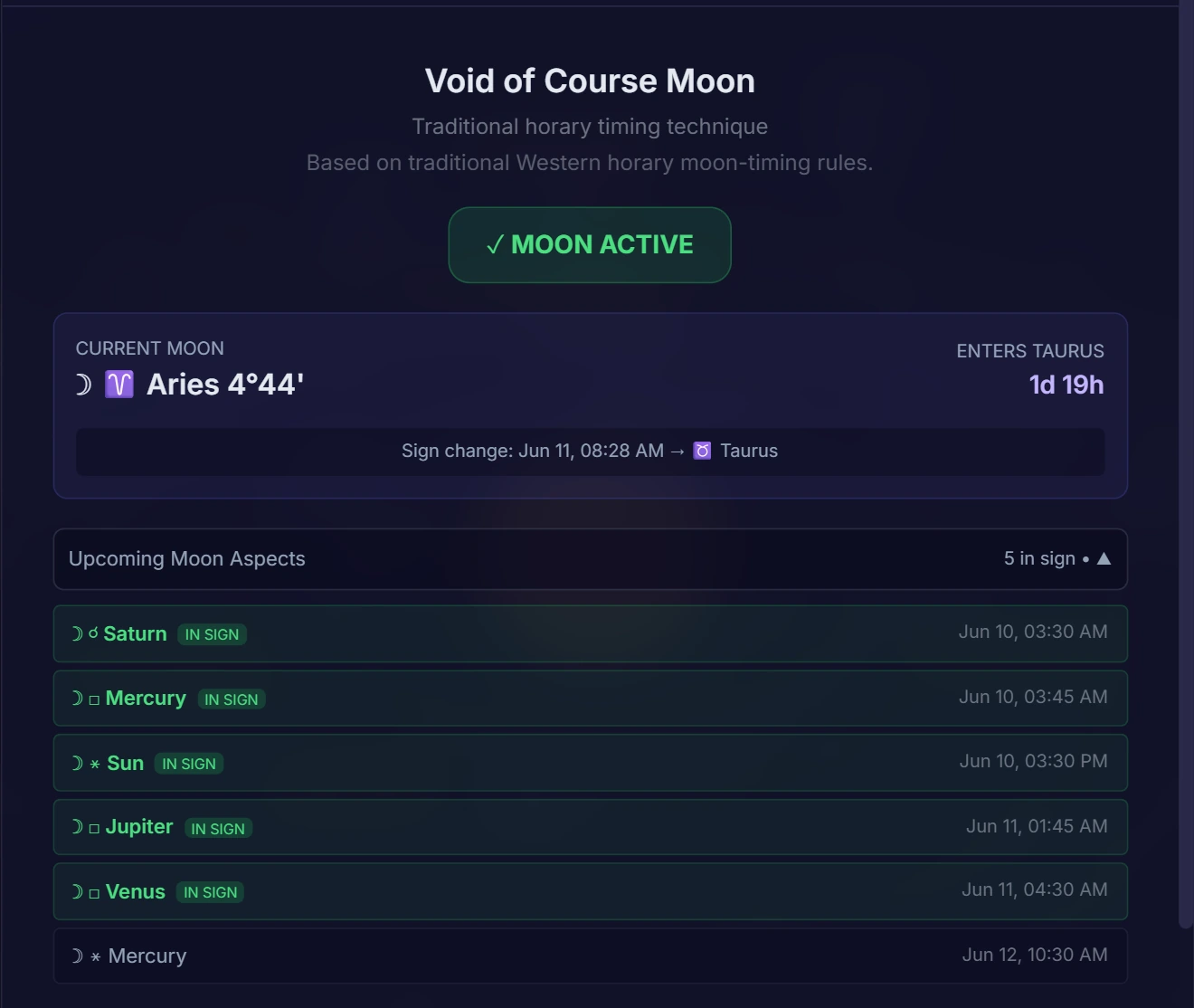
The box at the top answers the live question — it reads the Moon's current position from the Swiss Ephemeris (the same arc-second source professional astrologers use) and reports the sign and degree, the phase and percent illuminated, whether the Moon is currently void of course, and when it next changes sign. [src→ Moon position · Swiss Ephemeris]
As of June 9, 2026, 17:00 UTC, the Moon sits at 4°44′ Aries — a waning crescent, 36.5% lit, thinning toward the New Moon. It is not void of course: it still has aspects to perfect in Aries, beginning with a conjunction to Saturn on June 10 at 07:29 UTC. The Moon finally finishes its work in Aries with a square to Venus on June 11 at 08:22 UTC — and from that instant it is void of course until it enters Taurus at 12:28 UTC, roughly a four-hour gap. Every time on this page is given in UTC; the live page shows each one in your own zone (June's Eastern Time, for instance, runs UTC−4, so that 08:22 UTC void would begin at 04:22 ET).
The next void windows, and the next New & Full Moons
A void-of-course window opens at the Moon's last major aspect in a sign and closes when it crosses into the next sign. Here are the next eight, computed to the minute, each one named by the aspect that closes the Moon's business in its current sign. (Most are short — the texture is in when they fall, not how long they last.)
| Void begins (UTC) | Last aspect (in sign) | Void ends → enters | Length |
|---|---|---|---|
| Jun 11 · 08:22 | Moon □ Venus (Aries) | Jun 11 · 12:28 → Taurus | 4.1 h ← next |
| Jun 13 · 07:30 | Moon ⚹ Jupiter (Taurus) | Jun 13 · 13:05 → Gemini | 5.6 h |
| Jun 15 · 02:54 | Moon ☌ Sun (Gemini) | Jun 15 · 12:14 → Cancer | 9.3 h |
| Jun 17 · 07:40 | Moon ☌ Jupiter (Cancer) | Jun 17 · 12:05 → Leo | 4.4 h |
| Jun 19 · 11:30 | Moon ⚹ Sun (Leo) | Jun 19 · 14:36 → Virgo | 3.1 h |
| Jun 21 · 17:33 | Moon ⚹ Jupiter (Virgo) | Jun 21 · 20:54 → Libra | 3.4 h |
| Jun 24 · 04:11 | Moon □ Jupiter (Libra) | Jun 24 · 06:43 → Scorpio | 2.5 h |
| Jun 26 · 17:10 | Moon △ Jupiter (Scorpio) | Jun 26 · 18:40 → Sagittarius | 1.5 h |
Times shown in UTC for reference; the live page localizes each to your own zone, since a void that ends at 12:28 UTC is a different clock — and sometimes a different calendar day — in London, New York, and Sydney. [src→ void timings · Swiss Ephemeris]
The two lunations to know
| Event | When (UTC) | Where |
|---|---|---|
| Next New Moon | Jun 15 · 02:54 | 24°03′ Gemini (Moon ☌ Sun) |
| Next Full Moon | Jun 29 · 23:57 | Moon 8°15′ Capricorn ☍ Sun 8°15′ Cancer |
| Next First Quarter | Jun 21 · 21:55 | Libra |
| Next Last Quarter | Jul 07 · 19:29 | Aries |
Notice that the June 15 New Moon is the third void in the table: the Moon's very last aspect in Gemini is its conjunction with the Sun — the New Moon itself — at 02:54 UTC, which then leaves a long 9.3-hour coast to Cancer. A New Moon is, by definition, the Moon meeting the Sun; here it also happens to be the Moon's final Gemini aspect, which is why the void that follows is unusually long. [src→ lunation · Sun–Moon conjunction]
What "void of course" really is — the astronomy and the tradition
This is the part most worth understanding, because it takes the mystery (and the dread) out of the phrase. "Void of course" is not something happening to the Moon. The Moon keeps moving at its normal pace, in its normal direction, the whole time. The term describes a feature of the Moon's aspect schedule: a stretch when it will form no more major connections to a planet before it leaves the sign it's in.
Here is the mechanism. As the Moon travels through a sign — roughly two and a half days each — it forms aspects (conjunction, sextile, square, trine, opposition) to the planets one by one. At some point it makes its last such aspect for that sign. From that moment until it crosses into the next sign, it is "void of course" — running on, connected to nothing. [src→ void-of-course definition] The classical name in the Arabic tradition is vivid: Khali al-Sayr (al-qamar khālī al-sayr), "empty of course." [src→ void-of-course definition]
The Moon, traditionally, is the great connector of a chart — the fastest-moving body, the one that gathers the light of the others and carries it along. So a void Moon is read as a stretch where that connecting function is, for a few hours, switched off: the Moon is between conversations. That's the whole idea — not a curse, not a danger, just a gap in the Moon's contacts. [src→ Moon as significator]
A void Moon isn't a broken Moon. It's the Moon between conversations — finished talking in one sign, not yet arrived in the next. The pause is real; the alarm is optional.
Which definition? (it's a real, disclosed choice)
"Void of course" sounds exact, but astrologers make a methodological choice in how they measure it, and an honest live tool should say which one it uses. This page (and Zodisphere's engine) use the widely shared traditional standard: the seven classical planets (Sun, Mercury, Venus, Mars, Jupiter, Saturn — and the Moon's own aspects to them), the five Ptolemaic aspects, and sign boundaries — the Moon is void from its last major aspect in a sign until it enters the next sign (the Lilly / Al Morrison lineage). [src→ void-of-course methodology]
Some modern astrologers also count the outer planets (Uranus, Neptune, Pluto) or add the quincunx, which can give the Moon a later "last aspect" and so shorten a void — sometimes erasing one entirely. Neither approach is wrong; they're answering the same question with a different planet list. We name ours plainly so a void you see here can be reconciled with one you see elsewhere. [src→ void-of-course methodology]
Fact vs. folklore — held honestly
The void Moon may be the most quietly anxiety-producing idea in everyday astrology — partly because the internet flattened a precise traditional caution into a blanket "don't do anything." It's worth separating three layers, with respect for each.
| The claim | How to hold it |
|---|---|
| "The Moon goes void of course." | Astronomical description, gently clarified: the Moon doesn't slow, stop, or change. "Void" names a gap in its aspect schedule, not any event in the sky. The geometry is exact and real; the wording just sounds more dramatic than the fact. |
| "It's a poor time to begin something important." | Traditional doctrine: a genuine electional caution — a void Moon was counted among the conditions to avoid when starting a venture, because the matter tends to "perform nothing" — drift, stall, or come to little. Held as guidance about initiating, not a law of physics. [src→ void-of-course electional counsel] |
| "Never sign / never decide / it's cursed — do nothing." | Modern pop overstatement: a folk-memory of the real caution, amplified into a prohibition on all activity. The honest version: it's a steer away from launching — not from living. Routine, rest, reflection, and finishing were always considered fine, even favored. |
There is nothing here to scoff at. The caution comes from a careful tradition — electional astrologers timed ventures by the Moon for centuries, and they recorded the void Moon as one of several conditions under which a beginning tended to fizzle. [src→ ten conditions of the Moon in elections] Even at its most overstated, the modern version nudges people toward a genuinely good habit: don't kick off the big thing in the four-hour gap when the Moon is mid-coast; wait for it to land in the next sign. Better to treat a void as a small piece of timing to note than a thing to fear — and to remember that most of them are over before lunch.
What the phase and the sign actually signify
Two things color the Moon at any moment: its phase (how much of it the Sun is lighting, which tracks its angle to the Sun) and its sign (the slice of the zodiac it's moving through). Right now both point the same direction.
A waning crescent, 36.5% lit
The Moon is past Full and past its Last Quarter, on the waning side of the cycle — losing light each night as it closes the distance to the Sun for the June 15 New Moon. In the older electional tradition, the Moon's increasing light (waxing) was paired with building and fortifying — beginnings, growth, gathering — while its decreasing light (waning) was paired with extracting, clearing, releasing, and finishing. [src→ waxing/waning electional emphasis] A waning crescent is the tail of that arc: the traditional steer is toward completing and letting go rather than launching, which dovetails neatly with the "finish, don't start" feel of a void.
The Moon in Aries
Aries is a cardinal sign — one of the four that open the seasons (Aries, Cancer, Libra, Capricorn), and so carries an initiating, get-it-moving quality. [src→ cardinal/movable signs] A Moon here tends to read as quick, direct, and impatient for action — feelings that arrive fast and want a response now. [src→ Moon in Aries · sign temperament] It's a brisk, short-fuse Moon, good for momentum and decisive small moves. The interesting tension this week: that forward-leaning Aries Moon is in its waning phase and heading for a void — energy that wants to start, in a stretch the tradition reads as better for finishing. Worth knowing, not worth worrying over.
A void window, read phase by phase
Take the next void from the table — June 11 — and walk it the way a practitioner would, so you learn to read a window rather than just look one up.
- The last aspect — June 11, 08:22 UTC. The Moon, late in Aries, perfects its final major aspect there: a square to Venus. That square is the Moon's last piece of "business" in Aries — a brief bit of friction around comfort, value, or relationship, depending on your chart. Once it's exact, the Moon has nothing left to connect with before the sign ends.
- The void itself — 08:22 to 12:28 UTC (about 4 hours). From that square onward, the Moon coasts through the last degrees of Aries connected to nothing. This is the stretch the tradition flags for not launching the important new thing — and equally flags as fine for routine, finishing, and rest.
- The release — June 11, 12:28 UTC. The Moon crosses into Taurus, and the void ends the instant it does. The connecting function switches back on; the Moon begins making fresh aspects in a new, slower, steadier sign. If you were holding a beginning, this is the green light.
That's the rhythm under every row of the table: an aspect that closes the sign, a quiet coast, and a clean re-entry. Read a few of them this way and the void stops being a vague warning and becomes a small, legible piece of timing you can actually plan around.
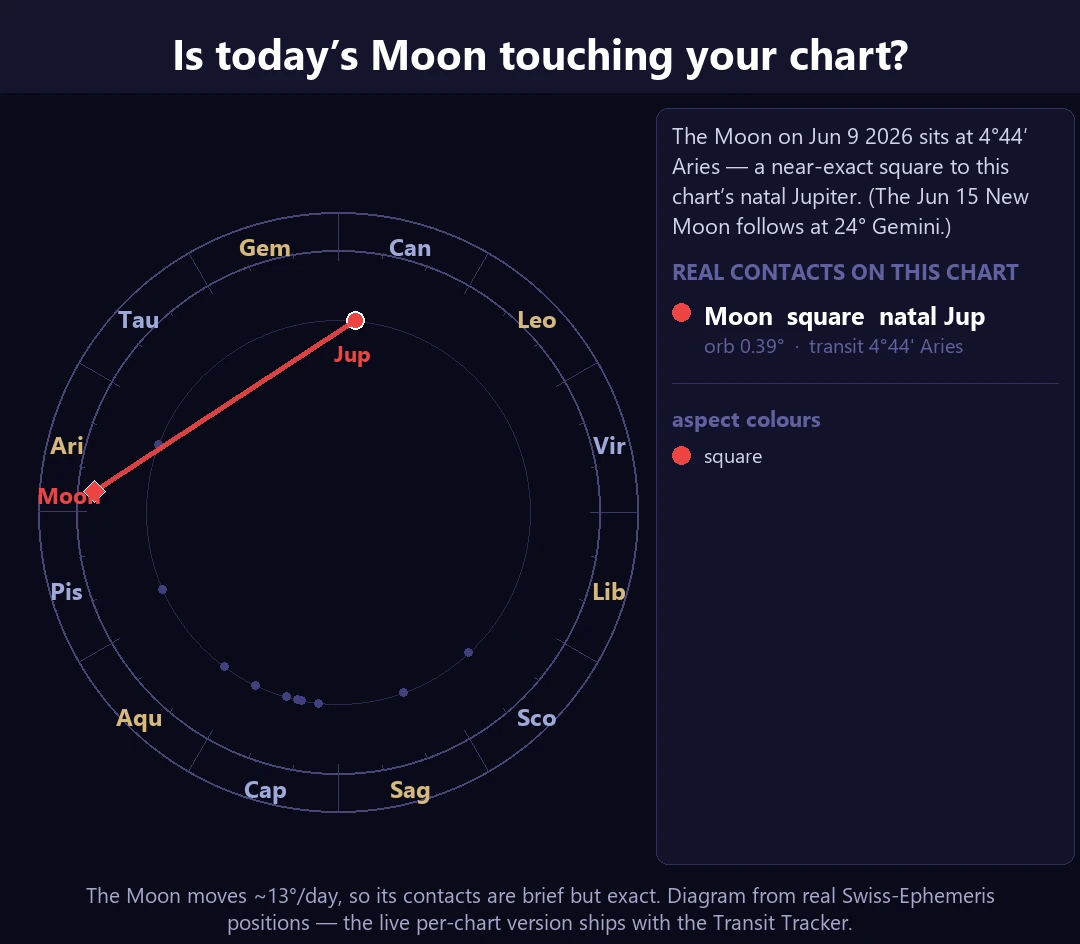
Is this Moon touching your chart?
A status box can show you the sky, but not your sky. The same Aries Moon, or the June 15 Gemini New Moon, lands very differently depending on where it falls in your chart. If this New Moon sits in a quiet patch of your chart, you may barely notice it. If it falls on your natal Sun, Moon, Ascendant, or a sensitive degree, it can mark a genuinely fresh start in whatever area of life that house governs. [src→ transits to natal]
That's a transit — a present-day Moon (or any body) making a geometric contact to a point in your birth chart — and it's the difference between a generic "the Moon is in Aries" note and a reading written for your actual sky.
If the void Moon makes you a little wary of starting things, that instinct stands on a long and careful tradition. Astrologers watched the Moon's coast between signs for centuries and read it as a cue: let the beginning wait a few hours for the Moon to land. That's not superstition — it's attention to timing, and attention to timing is rarely bad. We'd only rebalance it from dread toward discernment: most voids are brief and harmless, and the skill is simply telling a true beginning from ordinary life — then letting the Moon's timing inform the start rather than rule it.
See which voids — and Moons — actually land on your chart
Add your birth details and Zodisphere shows the live Void-of-Course Moon panel and a personal transit timeline: every void window and lunation, checked against your own chart and scored by significance, on a calendar you can browse and compare. Same Swiss Ephemeris precision, written for your sky, not the average one. Free.
Track your Moon & transits →