Saturn Return Calculator
- 1st pass (Saturn direct)Feb 7, 2019
- 2nd pass (Saturn retrograde)Jul 31, 2019
- 3rd pass (Saturn direct)Nov 4, 2019
- Exact-contact window~9 months (age 29)
<video> is a later optimization).Frequently asked
When is my Saturn return?
Why does it last three years — or does it?
Why do some people get three passes and others one?
What does the Saturn return mean?
Is the Saturn return always bad?
How accurate are these dates?
Your exact dates — not a vague "late twenties"
Most articles on the Saturn return will tell you it happens "around age 29–30." That's true, but it's the part you could have guessed. The useful question is: when, exactly — and on which days is it most concentrated? That depends entirely on where Saturn sat in your own birth chart, down to the degree, and a calculation that knows your chart can answer it precisely. [src→ Saturn return technique]
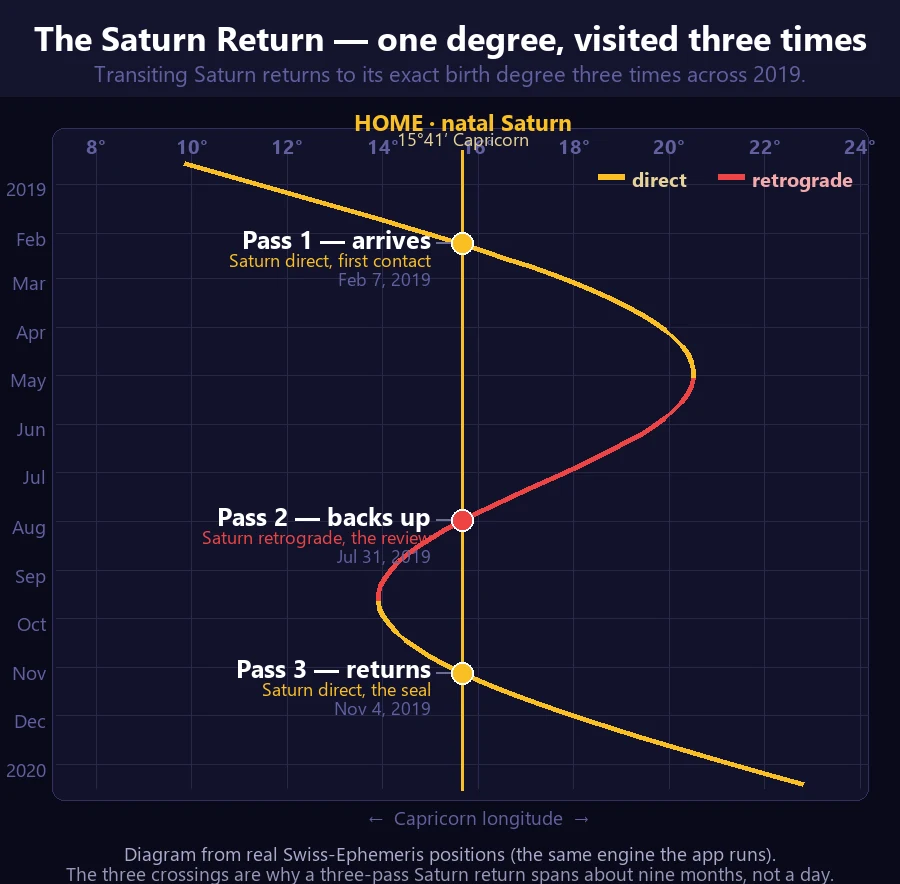
This page works the example for our sample chart — January 1, 1990, New York, with natal Saturn at 15°41′ Capricorn. Saturn returned to that exact degree three times across 2019, because it stationed retrograde partway through and re-crossed the point twice more:
| Pass | Date | Saturn's motion | What it marks |
|---|---|---|---|
| First exact | Feb 7, 2019 | Direct | The return opens — first real contact |
| Second exact | Jul 31, 2019 | Retrograde | The review pass — revisiting what surfaced |
| Third exact | Nov 4, 2019 | Direct | The seal — the lesson is set, forward again |
From first contact to last is about nine months here, centered on age 29. That precision is the whole point of computing it: someone living this in early 2019 would want to know that late July is the reflective middle pass, not assume the intensity is spread evenly across three flat years. The dates above each carry a "See this moment in 3D" link in the live tool, so you can open any one of them in the sky.
Stand inside the moment, in 3D

Knowing the date is one thing; seeing the sky is another. Because Zodisphere is a real-time solar-system viewer, each exact pass is also a place you can go. Open any return date in 3D and the app winds time forward to that exact moment — so you can watch transiting Saturn sitting precisely back on the degree it held at birth, in the round, from any angle you like.
It's a small thing that lands surprisingly hard: the planet of time, having taken twenty-nine years to circle once, standing again exactly where it stood the day you arrived. The view at the top of this page is that move on our sample chart; on the live tool, each result date opens it for real.
Why your Saturn return arrives near age 29
It's pure orbital mechanics, and it's the same for everyone. Saturn takes about 29.5 years to orbit the Sun once — its sidereal period. So roughly every 29½ years, Saturn comes back around to the exact zodiac degree it occupied at your birth. The first homecoming lands at about 29–30, the second near 58–60, the third (for the long-lived) near 87–88. [src→ Saturn sidereal period]
The exact age varies by a year or so from person to person, because Saturn's speed isn't constant — it moves a little faster near perihelion and slower near aphelion, and your own birth degree sits somewhere on that uneven track. [src→ Saturn sidereal period] Our sample chart's first exact pass lands at age 29.1. Yours might be 28½ or 30; an exact computation resolves it instead of rounding.
Saturn takes about 29½ years to circle the Sun — so once a generation, it returns to the exact spot it held at your birth. The first time, you're about 29. That homecoming is the Saturn return.
Why three passes — and how long it actually lasts
Here's where precision really earns its keep, because the popular "Saturn return lasts 2–3 years" is, honestly, a little loose — and worth unpacking rather than repeating.
Like all the planets beyond Earth, Saturn appears to station and turn retrograde once a year. Saturn is an outer, slower planet, so this is the familiar case of faster-moving Earth lapping it near opposition, which makes Saturn appear to drift backward for a few months — the same apparent-motion effect explained in full on our retrograde page. If your natal Saturn degree happens to fall inside the band Saturn retrogrades across that year, the planet crosses it three times: once going forward, once backing up, once going forward again — exactly our sample chart's Feb / Jul / Nov 2019. If your degree falls outside that retrograde band, Saturn crosses it just once, and the return is a single clean pass. Both are completely normal. [src→ retrograde re-crossings]
What a Saturn return actually means
Saturn is the tradition's planet of time, structure, limit and maturity — the boundary-keeper, the one that asks for patience, responsibility, and the slow earning of real authority over your own life. It is the symbol the older texts gave to the work of turning restriction and difficulty into wisdom. [src→ Saturn significations] So its return — Saturn standing again exactly where it stood when you began — has long been read as a coming of age: a reckoning where the provisional, borrowed shape of your twenties is tested against what's actually yours to build.
One classic reading frames the first return as the end of one complete life cycle — in terms of your whole life structure, your ambitions, your priorities, your character — and the opening of the next. [src→ Saturn return doctrine] In practice the tradition treats it less as punishment and more as consolidation: commitments get real or get released, half-built structures either get foundations or come down, and you start to author your life on your own authority rather than an inherited one. Careers crystallize or pivot; relationships deepen into commitment or end honestly; people often "feel their age" for the first time, in a way that is sobering but ultimately steadying. The work it asks for is rarely comfortable, but it is constructive — Saturn builds what lasts.
Read by house and sign — your return isn't generic
A Saturn return is never just "a Saturn return." Which part of life gets the reckoning depends on the house Saturn occupies in your chart, and the flavor of the lesson depends on its sign. This is, again, why reading your actual chart beats a one-size article. [src→ Saturn by house & sign]
| If your natal Saturn is in… | The return tends to concentrate on… |
|---|---|
| The 1st / 7th houses | Identity and self-definition · committed partnership and what you owe to "us" |
| The 2nd / 8th houses | Money, self-worth and security · shared resources, debt, intimacy, deep change |
| The 10th / 4th houses | Career, vocation and public standing · home, family, roots and inner foundations |
| The 3rd / 9th houses | Mind, learning, siblings and everyday contacts · higher study, travel, belief and meaning |
| The 5th / 11th houses | Creativity, romance, children and play · friendships, community, hopes and long-range goals |
| The 6th / 12th houses | Work, routine, health and service · solitude, retreat, the inner life and what's behind you |
| Our sample (Saturn in Capricorn, its own sign) | An especially "pure" Saturn flavor — structure, ambition, and earned authority front and center [src→ Saturn domicile] |
And because the sample chart's Saturn is in Capricorn — the sign Saturn itself rules — its return arrives, so to speak, on home turf: the tradition reads Saturn here as dignified, a particularly clear, structural, "build it properly this time" version of the lesson, with achievement and authority front and center. [src→ Saturn domicile] A Saturn in Pisces or Gemini would speak in a softer or more restless dialect. Reading your own chart surfaces yours.
First, second, and third returns
- First return (~age 29): the famous one — leaving the long adolescence of the twenties and stepping into authored adulthood. The structures you commit to here often define the next three decades.
- Second return (~age 58–60): a reckoning with what you built — harvest, legacy, and the honest reassessment that opens the door to elderhood. Saturn asks whether the structures still fit.
- Third return (~age 87–88): reached by the long-lived; traditionally a return to essentials, completion, and wisdom — what truly mattered, distilled.
Saturn has carried a heavy reputation since antiquity — the old texts called it the Greater Malefic, the planet of limit and hardship. We'd hold that name with respect but not with fear. The same tradition that named Saturn stern also taught that a malefic well-placed performs excellently — that Saturn is the maker of lasting things: discipline, mastery, real authority, the patience that builds what endures. A Saturn return is genuinely demanding, and we won't pretend otherwise — but it is the demand of a teacher, not a punisher. People very often look back on theirs as the season they finally became themselves. If you're inside one now, that's the spirit we'd offer it in. [src→ Greater Malefic]
Find your own natal Saturn — then stand inside the moment
Generate your free birth chart to read your natal Saturn's exact degree, house and sign — the three numbers that set your own return — then open the exact moment in Zodisphere's live 3D solar system. Same Swiss Ephemeris precision the professionals use. Free. (And when our Transit Tracker finishes rolling out, it will show everything else moving through your chart during the return season — until then, the 3D deep-link is the live action that works today.)
Generate my birth chart → or see the sample return in 3D →