Today's Transits: Where Every Planet Is Right Now
Frequently asked
Where are the planets right now?
What aspects are happening today?
What planets are in retrograde right now?
What sign is the Moon in today, and is it void of course?
Which transits matter most?
How do I see which transits are hitting MY chart?
Where every planet is right now
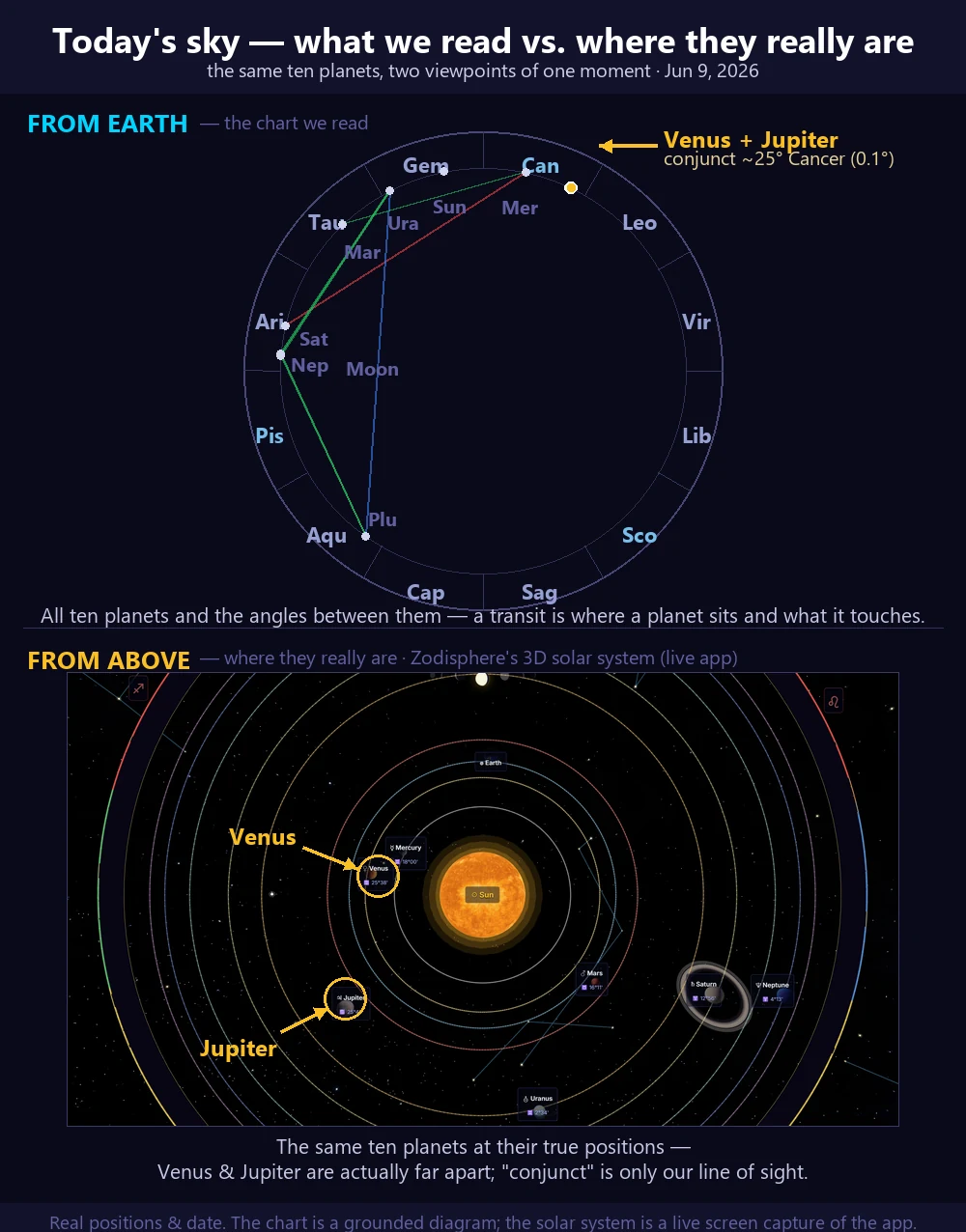
This is the foundation of every transit reading: the live position of each body, read from the Swiss Ephemeris (the same arc-second source professional astrologers use). Each planet has a sign and degree — its ecliptic longitude — and a motion: how fast it's moving, and whether forward (direct) or backward (retrograde). That speed is the single most useful number on the page, because it tells you how long anything the planet is doing will last. [src→ planet positions · Swiss Ephemeris]
| Planet | Position | Daily motion | Speed class |
|---|---|---|---|
| Sun | 18°52′ Gemini | +0.96°/day · direct | fast |
| Moon | 4°44′ Aries | +13.52°/day · direct | fastest |
| Mercury | 12°18′ Cancer | +1.29°/day · direct | fast |
| Venus | 25°38′ Cancer | +1.17°/day · direct | fast |
| Mars | 16°11′ Taurus | +0.73°/day · direct | medium |
| Jupiter | 25°45′ Cancer | +0.20°/day · direct | slow |
| Saturn | 12°56′ Aries | +0.07°/day · direct | slow |
| Uranus | 2°34′ Gemini | +0.06°/day · direct | very slow |
| Neptune | 4°13′ Aries | +0.015°/day · direct | very slow |
| Pluto | 5°15′ Aquarius | −0.014°/day · retrograde | very slow |
Positions shown for 2026-06-09 17:00 UTC; open the live 3D sky for each to the current minute, localized to your timezone. Note the spread of speeds — the Moon covers more sky in a day than Pluto does in two and a half years. That spread is the whole reason some transits are events and others are eras. [src→ planet speed · fast vs slow bodies]
What's retrograde right now
Only Pluto is retrograde today, near 5° Aquarius. A retrograde planet hasn't reversed its orbit — it only appears to drift backward against the stars as Earth's faster motion changes our viewing angle. (For the full geometry of that illusion, see our Mercury-retrograde explainer — it's the same effect for every planet.) Worth an honest note: Saturn and Neptune are nearly stationary — moving so slowly they look almost parked — because both are slowing toward retrograde stations later in the summer. But on this date they are still moving forward, so they count as direct. A page that called them retrograde today would be a day (or weeks) early. [src→ retrograde · apparent motion]
Today's exact aspects (tightest first)
An aspect is a meaningful angle between two planets — a conjunction (0°), sextile (60°), square (90°), trine (120°), or opposition (180°). The orb is how far the angle is from exact; the tighter the orb, the stronger the contact. Here are the major aspects in orb right now, sorted by tightness, with whether each is applying (closing toward exact — building) or separating (past exact — fading). [src→ applying vs separating]
| Aspect | Orb | Phase | Tempo |
|---|---|---|---|
| Venus ☌ Jupiter | 0.12° | applying — exact today (Jun 9) | fast (1–2 days) |
| Moon ☌ Neptune | 0.52° | separating | fleeting (hours) |
| Moon ⚹ Pluto | 0.52° | applying — exact ~today | fleeting (hours) |
| Mercury □ Saturn | 0.63° | applying — exact ~Jun 10 | fast (1–2 days) |
| Neptune ⚹ Pluto | 1.04° | applying | slow (months) |
| Uranus ⚹ Neptune | 1.65° | applying | slow (months) |
| Moon ⚹ Uranus | 2.17° | separating | fleeting (hours) |
| Uranus △ Pluto | 2.69° | applying | slow (months) |
| Mercury ⚹ Mars | 3.88° | applying — exact ~Jun 16 | fast (days) |
| Sun ⚹ Saturn | 5.94° | separating (wide) | fast (days) |
| Moon □ Mercury | 7.57° | applying — exact ~Jun 10 (wide) | fleeting (hours) |
Eleven aspects are in orb; eight of them are applying. Read the table top-down and a shape appears: the tightest, loudest contacts are fast ones (Venus–Jupiter, the Moon's, Mercury–Saturn), while the slow outer-planet aspects sit lower by orb but last far longer. The next two sections are about reading exactly that difference. [src→ aspect orbs · major aspects]
The aspect scope this page uses (a real, disclosed choice)
"Today's aspects" sounds like a fixed fact, but every tool makes a methodological choice in what it counts, and an honest live page should name it. This weather read uses the ten planets — Sun through Pluto — the five major (Ptolemaic) aspects (conjunction, sextile, square, trine, opposition), with 8° orbs for the conjunction, opposition, square, and trine, 6° for the sextile, and no extra "luminary" bonus for aspects to the Sun or Moon. [src→ aspect orbs · major aspects]
That's a deliberate, common middle-of-the-road setting — but it is a setting. Zodisphere's full natal wheel additionally tracks the lunar nodes, Chiron, and the chart angles, and its 2D/3D aspect view applies a small extra orb for aspects to the Sun and Moon — this ten-planet weather view deliberately keeps a tighter, simpler net so the live read stays uncluttered. Beyond that, some astrologers use the minor aspects (semisextile, quincunx, and the like), and orbs vary from tight (a few degrees) to generous (10°+) from one school to the next. None of those choices is "right" or "wrong" — they answer the same question with a different net. We name ours plainly so an aspect you see here can be reconciled with one you see on another tool. [src→ aspect orbs · major aspects]
Which transits actually matter — and how to tell
This is the part most "today's transits" pages skip, and it's the whole skill. The sky always has a dozen things happening at once; learning to read transits is mostly learning which ones to weight. Three questions sort them. [src→ outer-planet transit weight]
1. Speed sets duration
How long a transit lasts is set almost entirely by how fast the transiting planet moves. The fastest bodies — the Moon (about 13° a day), then the Sun, Mercury, and Venus — make and break aspects in hours to a day or two. The slow outer planets — Jupiter, Saturn, Uranus, Neptune, Pluto — can hold an aspect for months or years. In the traditional reading, the slow bodies mark the broad developmental periods and the long themes of a life, while the fast bodies supply the precise timing that brings those themes to a head on a particular day. [src→ outer-planet transit weight] So today's Venus–Jupiter conjunction is a one-or-two-day grace note, while Neptune sextile Pluto is the kind of slow contact the whole season shares.
2. Applying vs separating sets the phase
An aspect has a direction in time. While its orb is closing toward exact, it is applying — building, gathering, on the way in. Once the planets have perfected the angle and the orb begins to widen, it is separating — discharging, fading, on the way out. Traditionally an applying aspect is the stronger, ripening half and a separating one the weakening half. [src→ applying vs separating] It's why the table marks each: a tight aspect that's still applying is the one to watch; a tight aspect that's already separating has mostly spent itself. Today, Venus–Jupiter and Mercury–Saturn are applying (building); the Moon's conjunction to Neptune is already separating (fading).
3. Tight vs wide orb sets the volume
The closer to exact, the louder. A contact at a tenth of a degree — like today's Venus–Jupiter — is at full volume; the same pair at 6° or 7° apart is a faint background hum. This is why a list sorted by tightness tells you more than a list sorted by mere presence: a wide aspect is technically "in orb" but is usually not doing much yet, or anymore. When several transits describe the same theme, practitioners even average their orbs to find the moment the combined contact peaks — the instant the math lands closest to exact. [src→ orb · mean-orb timing]
Today's sky has eleven aspects in it, but they are not equal. Speed says how long each lasts, phase says whether it's building or fading, and orb says how loud it is right now. Read those three and the busy sky resolves into a few things that actually matter.
The slow background vs the fast foreground
Put speed and orb together and the day's sky splits cleanly into two layers — and seeing both is the difference between reading the weather and just listing it.
The slow background is made of the outer-planet aspects: today, Neptune sextile Pluto, Uranus sextile Neptune, and Uranus trine Pluto. Because Uranus, Neptune, and Pluto crawl — a few hundredths of a degree a day — these contacts hold for months, sometimes years. They are the long weather the whole period shares; they don't change from one morning to the next, and because they touch the entire generation alive under them, they read as collective, mundane themes more than personal ones. You don't feel them tick; you feel the season they set. [src→ outer-planet transit weight]
The fast foreground is everything the quick bodies are doing on top of that background: Venus conjunct Jupiter exact today, the Moon's hourly aspects, Mercury closing its square to Saturn. These are the bright, brief notes — the day's texture. A fast planet often acts as the trigger that brings a slow background theme to a head on a specific date, which is exactly why precise daily timing comes from the fast bodies even though the deep themes come from the slow ones. [src→ inner-planet transit timing]
What the Moon is doing
The Moon is the fastest mover in the chart and the quickest-changing part of any "today" read — it covers about 13° a day, so it changes sign every two and a half days and makes and breaks its aspects within hours. Right now it sits at 4°44′ Aries, a waning crescent (36.5% lit), thinning toward the New Moon, and it is not void of course at this moment. [src→ Moon position · Swiss Ephemeris]
Because the Moon's timing is its own deep topic — the void-of-course windows, the exact phase math, the next New and Full Moons — we keep it on its own page rather than repeat it here. For the full lunar read, see the Moon right now: phase, sign & void of course.
A worked example: reading Venus ☌ Jupiter today
Take the day's headline aspect and read it the way a practitioner would, so the table stops being a list and becomes something you can interpret.
- What it is. Venus (25°38′ Cancer) and Jupiter (25°45′ Cancer) are within 0.12° of an exact conjunction — almost the same point of sky. These are the two traditional benefics: Venus the lesser, Jupiter the greater. Their meeting is read as one of the more genial, expansive, good-humored aspects in the calendar — warmth, generosity, ease — colored here by Cancer's home-and-family register. [src→ Venus & Jupiter significations]
- It's applying, then exact, then separating. The orb is 0.12° and still closing — so the aspect is applying, and it perfects a few hours after this 17:00 UTC snapshot, the same day (Venus, at 25°38′, is catching Jupiter at 25°45′ from behind). From there it begins to separate, and because Venus pulls ahead about 0.97° a day faster than Jupiter, the pairing widens out of orb within a day or two. That's the whole life of the contact: a brief, bright build to exact, then a quick fade.
- How you know it's a fast event, not an era. The tell is in the speed column: Venus is a fast planet, so anything it does is measured in days. Contrast that with Neptune sextile Pluto lower in the table — both very-slow planets, an aspect that's been forming for months and will hold for months more. Same word, "aspect"; utterly different timescale. Reading the speed first tells you which kind you're looking at before you read anything into it. [src→ outer-planet transit weight]
That's the rhythm under every row of the aspects table: identify the bodies, check the orb and whether it's applying or separating, and — first of all — read the speed, because the speed tells you whether you're looking at a passing note or a long chord.
Is today's sky actually touching your chart?
Here's the limit of any "today's transits" page, this one included: the sky above is the same for everyone alive. Venus conjunct Jupiter is exact at 25° Cancer for the whole planet at once. It only becomes yours where a present-day planet makes a geometric contact to a placement in your birth chart — your Sun, Moon, Ascendant, or any natal point. [src→ transits to natal]
That contact is a transit: a present-day planet aspecting a position in your natal chart. If today's Venus–Jupiter conjunction lands in a quiet patch of your chart, you may barely register it; if it falls exactly on your natal Sun or Moon, it can be one of the warmer days of your season. The same is true of the slow outer-planet background — a Neptune–Pluto sextile that touches a sensitive degree in your chart is doing something specific to you that the generic sky can't tell you. The bridge from "the sky" to "my sky" is checking today's positions against your actual chart.
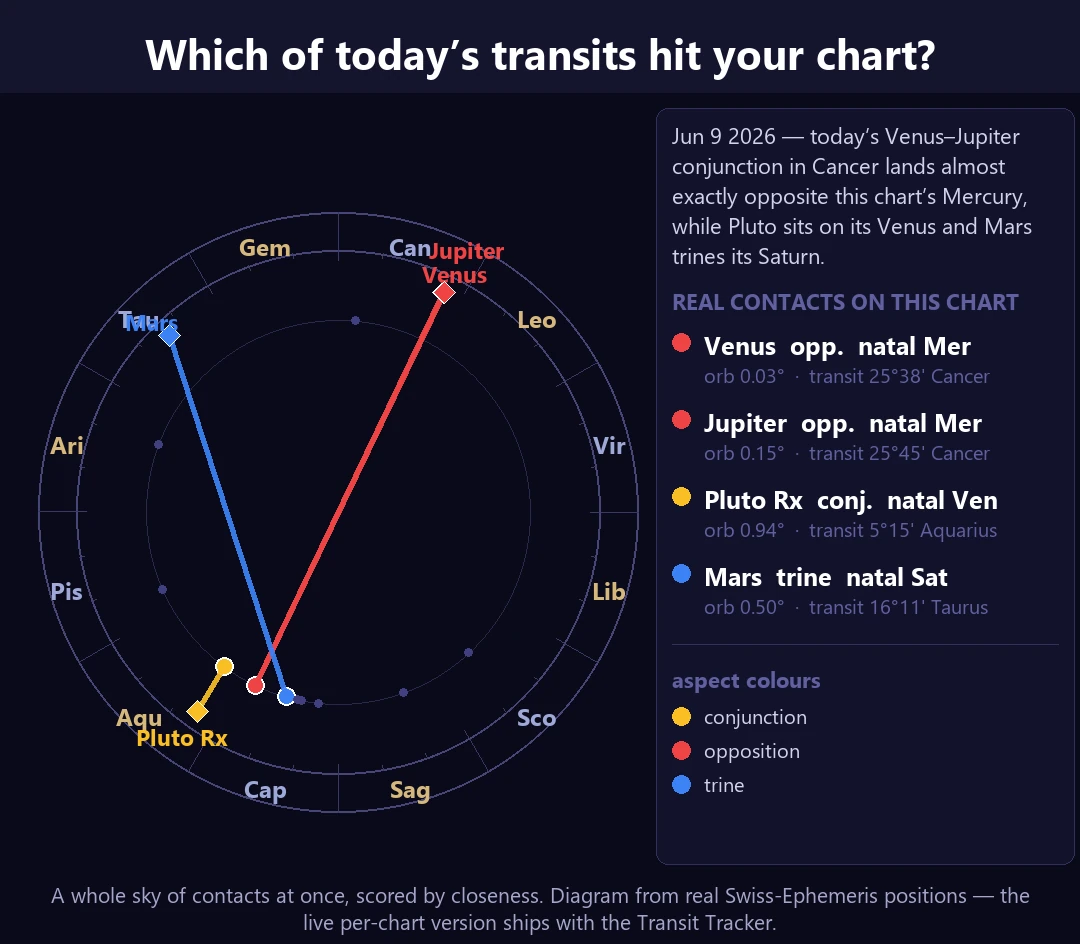
People have watched the planets' daily march and read meaning into their meetings for thousands of years — long before anyone could compute an orb to a tenth of a degree. The instinct to look up and ask "what's the sky doing today?" is an old and good one. All we've added is precision and a way to check the general sky against your particular one. The aim isn't to replace the wonder with a dashboard — it's to let the wonder rest on accurate ground.
See which of today's transits land on your chart
Add your birth details and Zodisphere's Transit Tracker checks the live sky against your own chart: every contact today's planets make to your natal placements, scored by significance, on a calendar you can browse and compare. Same Swiss Ephemeris precision, written for your sky, not the average one. Free. (The Transit Tracker is rolling out from our transit-tracking work; until it lands on the main app you can still explore today's whole sky live above.)