What Planets Are in Retrograde Right Now?
Frequently asked
What planets are in retrograde right now?
Is Mercury (or Mars, Venus, Saturn…) retrograde right now?
When is the next retrograde, and which planet?
What planets are retrograde in 2026 — the full calendar?
What does it mean when a planet is in retrograde?
Why is an outer-planet retrograde so much longer than Mercury's?
How do I know if a retrograde is affecting me personally?
What's retrograde right now
The box at the top answers the live question — it reads every planet's motion from the Swiss Ephemeris (the same arc-second source professional astrologers use) and reports which are moving backward (retrograde) and which forward (direct). As of June 9, 2026, 17:00 UTC, the answer is short: only Pluto is retrograde, near 5° Aquarius, creeping backward at about 0.014° a day. [src→ planet motion · Swiss Ephemeris]
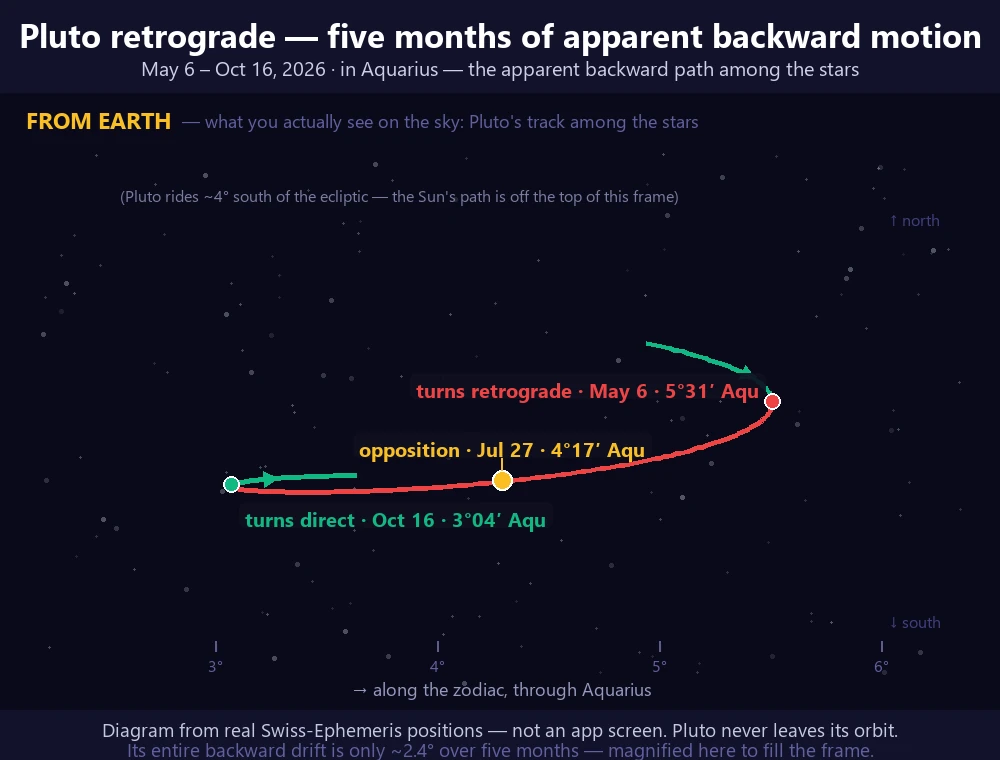
That single retrograde is worth a closer look, because it's a perfect example of the kind most "what's retrograde now" headlines misread. Pluto is the slowest of the planets, and its retrograde — running May 6 to October 16, 2026 (about 162 days, roughly five and a half months) — is not a sudden event. It's the long, ordinary inward phase the planet keeps every year. [src→ outer-planet retrograde duration] Two other planets, Saturn (12°56′ Aries) and Neptune (4°13′ Aries), are barely moving — slowing toward their own retrograde stations later in the summer — but on this date they are still inching forward, so they count as direct. A page that called them retrograde today would be weeks early. For where every planet sits and what it's aspecting right now, see today's transits.
Most of the year, something slow is retrograde — and that's completely ordinary. The skill isn't fearing retrogrades; it's knowing which one is which, because a three-week Mercury and a five-month Pluto are not the same kind of event at all.
The full 2026 retrograde calendar
Here is every planet's retrograde for 2026, in the order each begins, computed to the day. (Stations are slow, so day-level dates are exact enough; the live 3D sky shows each to your zone, to the current minute.) Two of these — Uranus and Jupiter — actually began retrograde in late 2025 and finish in early 2026; two more (Uranus again, and Jupiter again) begin in late 2026 and finish in 2027. Mars is absent: it has no retrograde this year at all. (Each degree below is the planet's degree at that station — where it turns — not its position today, which is why Pluto's May station at 5°31′ differs from its 5°15′ right now.) [src→ station dates · Swiss Ephemeris]
| Planet | Stations retrograde | Stations direct | Length | Sign(s) |
|---|---|---|---|---|
| Uranus | Sep 6, 2025 · 1°28′ Gem | Feb 4 · 27°28′ Tau | ~151 d | Taurus–Gemini |
| Jupiter | Nov 11, 2025 · 25°09′ Can | Mar 11 · 15°05′ Can | ~119 d | Cancer |
| Mercury | Feb 26 · 22°34′ Pis | Mar 20 · 8°29′ Pis | ~23 d | Pisces |
| Pluto | May 6 · 5°31′ Aqu | Oct 16 · 3°04′ Aqu | ~162 d | Aquarius ← now |
| Mercury | Jun 29 · 26°15′ Can | Jul 23 · 16°19′ Can | ~24 d | Cancer ← next |
| Neptune | Jul 7 · 4°25′ Ari | Dec 12 · 1°37′ Ari | ~158 d | Aries |
| Saturn | Jul 26 · 14°45′ Ari | Dec 10 · 7°56′ Ari | ~137 d | Aries |
| Uranus | Sep 10 · 5°42′ Gem | Feb 8, 2027 · 1°41′ Gem | ~151 d | Gemini |
| Venus | Oct 3 · 8°29′ Sco | Nov 14 · 22°52′ Lib | ~42 d | Libra–Scorpio |
| Mercury | Oct 24 · 20°59′ Sco | Nov 13 · 5°02′ Sco | ~20 d | Scorpio |
| Jupiter | Dec 13 · 27°01′ Leo | Apr 13, 2027 · 17°00′ Leo | ~121 d | Leo |
Read the Length column top to bottom and the whole point of this page appears: Mercury's three retrogrades clock in at ~3 weeks each, Venus at ~6 weeks, and every outer planet at four to five and a half months. Same word — "retrograde" — wildly different timescales. The next two sections are about reading exactly that difference. [src→ outer-planet retrograde duration]
The next planet to station retrograde
After today, the next station belongs to Mercury, on June 29 — a classic ~three-week window — and then the slow planets begin queuing up, each opening a months-long season. Here are the next six in order:
- Jun 29 — Mercury stations retrograde at 26°15′ Cancer (direct again Jul 23). The familiar three-week one. For its full geometry, shadow period, and what a Mercury retrograde traditionally means, see our dedicated Mercury-retrograde page.
- Jul 7 — Neptune at 4°25′ Aries. A ~five-month inward season (direct Dec 12).
- Jul 26 — Saturn at 14°45′ Aries. About 4.5 months (direct Dec 10).
- Sep 10 — Uranus at 5°42′ Gemini. About five months, finishing in February 2027.
- Oct 3 — Venus at 8°29′ Scorpio. A ~six-week retrograde (direct Nov 14) — the only Venus retrograde of the year.
- Oct 24 — Mercury at 20°59′ Scorpio. Mercury's third and last for 2026 (direct Nov 13).
What a retrograde means — and why fast vs. slow planets differ
This is the part most "what's retrograde now" pages skip, and it's the whole skill. A retrograde's meaning — and its length — scale almost entirely with how fast the planet moves. Read that one fact and a busy retrograde year resolves into a few very different kinds of season.
The fast planet: Mercury (~3 weeks, three times a year)
Mercury is the fastest planet, and it retrogrades the most often — about three times a year, three weeks each. It's the famous one, and the tradition reads it the way it reads Mercury itself: the planet of mind and exchange — communication, learning, commerce, contracts, short travel — turning inward and backward, toward the prefix "re-": review, revise, reconnect, repair, finish, rather than launch cold. [src→ retrograde meaning] It's frequent, brisk, and personal — which is exactly why it dominates the headlines. For the full Mercury treatment — the shadow period, the stations, the fact-vs-folklore of "don't sign anything" — that's its own page; we won't re-teach it here.
The slow planets: Saturn, Uranus, Neptune, Pluto (~5 months, most of the year)
The outer planets are a different creature entirely. Because they crawl — a few hundredths of a degree a day — Earth's faster motion makes each one appear to drift backward for a long stretch every single year: Saturn for about 4.5 months, Uranus, Neptune, and Pluto for roughly five months each. The slow three are retrograde for nearly 40% of the year. [src→ outer-planet retrograde duration]
That changes how the tradition reads them. An outer-planet retrograde is not a rare alarm — it's the ordinary background condition of the sky for almost half the calendar. Astrologically, the slow retrograde is read as a long turn inward on that planet's deep theme rather than a "things go wrong" warning: Saturn toward structure, responsibility, and what's load-bearing in a life; Pluto toward depth and transformation; the energy is felt internally, reviewed and reworked rather than externally launched. [src→ retrograde meaning] Older texts describe a retrograde planet's significations as delayed, internalized, or turned to an inward processing — and for a planet that holds that condition for five months, that's a season, not an incident. [src→ retrograde meaning]
Because the slow planets are retrograde so much of the time, most of any year has something retrograde in it — and that's normal, not ominous. The tradition that recorded these motions wasn't cataloguing disasters; it was tracking a rhythm of outward and inward phases. And here's the year's quiet good news: Mars — the planet pop culture most loves to dread in retrograde — doesn't retrograde at all in 2026. Its last was in early 2025; its next isn't until early 2027. The point of a page like this isn't to hand you a list of things to fear. It's to let you tell a brisk three-week review apart from a long, ordinary inward season — and to meet each with attention rather than alarm.
Is each planet retrograde right now? (the quick list)
For the specific "is Mercury / Mars / Venus…?" searches, here's every planet's status as of June 9, 2026, 17:00 UTC, with its next retrograde. Only one answer is "yes" today. [src→ planet motion · Swiss Ephemeris]
| Planet | Retrograde now? | Current position | Next / current retrograde |
|---|---|---|---|
| Mercury | No — direct | 12°18′ Cancer | Jun 29 → Jul 23 (Cancer) |
| Venus | No — direct | 25°38′ Cancer | Oct 3 → Nov 14 (Lib–Sco) |
| Mars | No — direct | 16°11′ Taurus | none in 2026 (next early 2027) |
| Jupiter | No — direct | 25°45′ Cancer | next stations Dec 13 (Leo) |
| Saturn | No — direct | 12°56′ Aries | Jul 26 → Dec 10 (Aries) |
| Uranus | No — direct | 2°34′ Gemini | Sep 10 → Feb 8 ’27 (Gemini) |
| Neptune | No — direct | 4°13′ Aries | Jul 7 → Dec 12 (Aries) |
| Pluto | Yes — retrograde | 5°15′ Aquarius | May 6 → Oct 16 (Aquarius) |
The Sun and Moon are not on this list because they never retrograde — from Earth they only ever move forward through the zodiac. "Retrograde" applies to the eight planets above. [src→ planet motion · Swiss Ephemeris]
What "retrograde" really is (one paragraph)
No planet actually reverses its orbit. Every planet keeps circling the Sun in the same direction the whole time; the "backward" motion is apparent — an effect of watching one moving body from another. As Earth and a planet travel at different speeds, there are stretches where our changing viewing angle makes the planet appear to slow, stop (the station), drift backward against the fixed stars, stop again, and resume forward. It's the same illusion as a slower car seeming to slide backward as you pass it on the highway. [src→ apparent motion] The geometry plays out a little differently for the fast inner planets than for the slow outer ones, and the still-points — the stations — are traditionally read as the most concentrated, "loudest" part of any retrograde. [src→ station significance] We keep this short on purpose: for the full apparent-motion geometry, with the synced reality-vs-perception view, that's the heart of our Mercury-retrograde explainer, and it works the same for every planet here.
Is a retrograde actually touching your chart?
Here's the limit of any "what's retrograde now" page, this one included: the sky above is the same for everyone. Pluto is retrograde at 5° Aquarius for the whole planet at once. It only becomes yours where a retrograde planet sits on, or makes a geometric contact to, a placement in your birth chart — your Sun, Moon, Mercury, Ascendant, or any natal point. [src→ transits to natal]
That contact is a transit: a present-day planet aspecting a position in your natal chart. If June's Mercury retrograde stations in a quiet patch of your chart, you may barely register it; if it stations exactly on your natal Sun, it can be one of the more pointed few weeks of your year — and which themes light up depends on the house and planet it touches. The slow retrogrades work the same way, just stretched over months: a Saturn or Pluto retrograde that lands on a sensitive degree of your chart is doing something specific to you that the generic sky can't tell you.
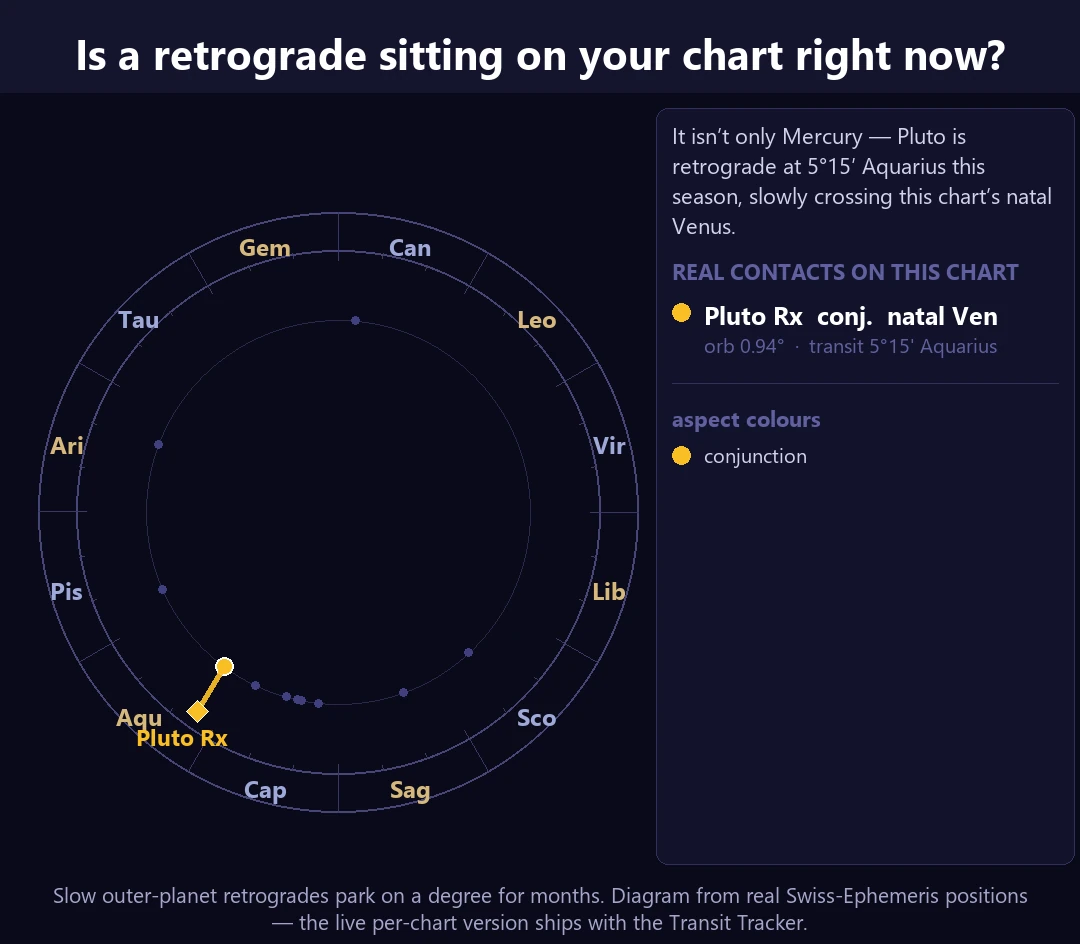
See which retrogrades — and every other transit — land on your chart
Add your birth details and Zodisphere's Transit Tracker checks each station against your own chart: which retrogrades touch your natal placements, on which days, scored by significance, on a calendar you can browse and compare. Same Swiss Ephemeris precision, written for your sky, not the average one. Free. (The Transit Tracker is rolling out from our transit-tracking work; until it lands on the main app you can already explore today's whole sky live above.)